
Army West Point Athletics
Payne Travels to Haiti for Unique Experience
May 01, 2017 | Men's Soccer
WEST POINT, N.Y. – Earlier last month, Army West Point head men's soccer coach Russell Payne got to experience something not many do.
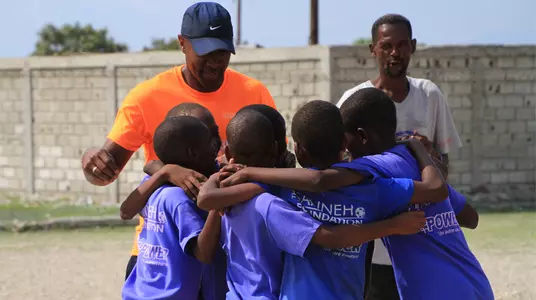
Payne, who will head into his eighth season at the helm of the Black Knights' program in 2017, traveled to Cite Soleil, Haiti, as part of The Sanneh Foundation. During his week-long trip, Payne helped use soccer to promote mutual understanding, social cohesion and female empowerment of youth and community coaches in Haiti and the United States.
Cite Soleil has an estimated 200,000 people with 29,000 people per square mile. Most of the residents of Cite Soleil are unemployed and a majority of the population are children. Some of the children Payne got an opportunity to work with are homeless and parentless. Those children lack access to school, education, and safe places to play sports. They rarely have the opportunity to just be children.
"The level of poverty and lack of basic infrastructure is devastating," Payne said. "The residents of Cite Soliel, especially the children, have little to no support in terms of basic human needs. Daily food, drinking water, sanitation, health care, education etc. are almost non-existent. Nonetheless they brought boundless enthusiasm and spirit to share every day with us on and off the field. They love soccer, they love learning and through the medium of sport, we were able to provide an educational experience designed to contribute to personal development."
This trip was made possible by the United States Department of State International Sports Programming Initiative (ISPI). The ISPI program allows U.S. non-profit organizations like The Sanneh Foundation to partner with foreign organizations and community partners that share an interest in using sport to design and implement exchange programs that address important social issues.
Payne and the 20 other participants of The Sanneh Foundation teamed up with the Haitian Initiative, which was founded by now retired U.S. Men's Soccer National Team player and 2002 FIFA World Cup veteran Tony Sanneh after he visited Haiti following the 2010 earthquake.
The program provided over 50 Haitian and American youth and community coaches with intercultural experiences and created mutual understanding between the two countries. Youth and coaches selected for participation explored how soccer can be part of the effort to decrease violence against females by creating healthier attitudes toward gender and masculinity.
"We got a chance to feed the children, track their English and math development, coach the kids, coach the coaches, and learn from them the value of perseverance in an environment where every day is truly a test of the heart, mind, body, and human spirit," Payne added.
The joint program is in effect six days a week and provides one meal per day, while also teaching English and math to approximately 350 Haitian youths. In order to be eligible for the program, each student must attend school every day and come directly to the program facility after. The program runs year-round and employs about 30 Haitian soccer coaches, which were trained by The Sanneh Foundation.
This one-of-a-kind experience will be something Payne won't soon forget. He hopes to take what he learned from the Haitian people and implement that into his coaching style here at West Point.
Payne, who will head into his eighth season at the helm of the Black Knights' program in 2017, traveled to Cite Soleil, Haiti, as part of The Sanneh Foundation. During his week-long trip, Payne helped use soccer to promote mutual understanding, social cohesion and female empowerment of youth and community coaches in Haiti and the United States.
Cite Soleil has an estimated 200,000 people with 29,000 people per square mile. Most of the residents of Cite Soleil are unemployed and a majority of the population are children. Some of the children Payne got an opportunity to work with are homeless and parentless. Those children lack access to school, education, and safe places to play sports. They rarely have the opportunity to just be children.
"The level of poverty and lack of basic infrastructure is devastating," Payne said. "The residents of Cite Soliel, especially the children, have little to no support in terms of basic human needs. Daily food, drinking water, sanitation, health care, education etc. are almost non-existent. Nonetheless they brought boundless enthusiasm and spirit to share every day with us on and off the field. They love soccer, they love learning and through the medium of sport, we were able to provide an educational experience designed to contribute to personal development."
This trip was made possible by the United States Department of State International Sports Programming Initiative (ISPI). The ISPI program allows U.S. non-profit organizations like The Sanneh Foundation to partner with foreign organizations and community partners that share an interest in using sport to design and implement exchange programs that address important social issues.
Payne and the 20 other participants of The Sanneh Foundation teamed up with the Haitian Initiative, which was founded by now retired U.S. Men's Soccer National Team player and 2002 FIFA World Cup veteran Tony Sanneh after he visited Haiti following the 2010 earthquake.
The program provided over 50 Haitian and American youth and community coaches with intercultural experiences and created mutual understanding between the two countries. Youth and coaches selected for participation explored how soccer can be part of the effort to decrease violence against females by creating healthier attitudes toward gender and masculinity.
"We got a chance to feed the children, track their English and math development, coach the kids, coach the coaches, and learn from them the value of perseverance in an environment where every day is truly a test of the heart, mind, body, and human spirit," Payne added.
The joint program is in effect six days a week and provides one meal per day, while also teaching English and math to approximately 350 Haitian youths. In order to be eligible for the program, each student must attend school every day and come directly to the program facility after. The program runs year-round and employs about 30 Haitian soccer coaches, which were trained by The Sanneh Foundation.
This one-of-a-kind experience will be something Payne won't soon forget. He hopes to take what he learned from the Haitian people and implement that into his coaching style here at West Point.
 |
 |
 |



Big Stick Check Leads to an Army Goal
Tuesday, April 07
Army vs. American Women's Lacrosse Game Highlights
Monday, April 06
Army vs. Lehigh Men's Lacrosse Game Highlights
Saturday, April 04
Army vs. Lafayette Women's Lacrosse Game Highlights
Saturday, April 04