Army West Point Athletics
Feinstein's Findings: A Long Day
November 15, 2020 | Football
ABOUT JOHN FEINSTEIN: John Feinstein is the author of 42 books, including the two best-selling sports books of all time: "A Season on The Brink," and "A Good Walk Spoiled," both No. 1 New York Times bestsellers. Twelve of his books have been mysteries written for kids. The first of these, "Last Shot," won The Edgar Allen Poe Award for mystery writing and was also a New York Times bestseller. His most recent non-fiction book, "The Backroads to March," was his 24th New York Times bestseller. His 36th book, "The Legends Club," chronicles the rivalries and relationships among Mike Krzyzewski, Dean Smith and Jim Valvano.
In addition to his books, John also works for The Washington Post and is a contributor to Golf Digest, Army Football radio network and UMBC basketball. He has been inducted into The Naismith Basketball Hall of Fame; The National Sportswriters and Sportscasters Hall of Fame; The U.S. Basketball Writer's Hall of Fame and the Greater D.C. Jewish Sports Hall of Fame.
He is a graduate of Duke University and lives in Potomac, Maryland with his wife Christine and has three children: Danny, Brigid and Jane.
Well, that was embarrassing.
The case can be made that the final score Saturday in New Orleans: Tulane-38, Army-12 was a bit deceiving. Tulane's last touchdown came on a poorly conceived and executed trick play attempt by Army on a kickoff. The Green Wave's previous touchdown was set up when a desperate Army team tried a fake punt on fourth-and-11 from its own 19-yard line that was stopped for a two-yard-loss.
But even if you discount those two late scores, there's no doubt that Army was outplayed for most of the afternoon. The Black Knights had three turnovers—one on the kickoff and two interceptions. They moved the ball in fits and starts but could never find any real consistency. They even had an extra point blocked, a play that loomed large at halftime with Tulane leading 14-12 but became moot when the home team dominated the second half.
The best news about the day? Tulane isn't on next year's schedule.
The Green Wave has been Coach Jeff Monken's Kryptonite since he arrived at West Point in 2014. As much progress as the program has made in the last seven years—including this year's record of 6-2—the Black Knights haven't been able to beat Tulane.
They have lost heartbreakers and they have lost semi blowouts. They've played Tulane four times since 2015; losing late—34-31--in the first meeting and 21-17 two years later after a couple of controversial calls on the Green Wave's game-winning drive. A year ago, it was 42-33 in Michie Stadium, ending Army's 15 game home winning streak, though the final margin was deceptively close.
This time, it was the opposite: the 26-point difference on the scoreboard at the finish was more a reflection of Army being burned trying to find a late miracle as the difference between the two teams.
"I thought we had a great chance to win the game," Monken said in his postgame comments. A couple of moments later, he repeated the thought.
He wasn't entirely wrong. At halftime, the visitors appeared to have the momentum and there was, at the very least, reason to believe that the game wouldn't be decided until the final minutes.
That notion proved to be wrong.
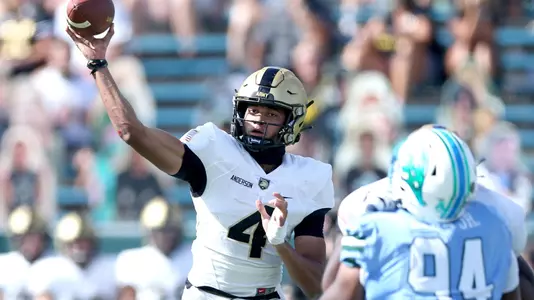
Army hadn't played a game in three weeks—a bye, followed by the Air Force postponement—and it showed early. Christian Anderson was back in the lineup at quarterback for the first time since the Abilene Christian game six weeks ago.
His start was a microcosm of the entire team's start: rusty, slow, just not quite with it. The Black Knights went three-and-out on their first series and then Zach Harding got off his worst punt of the season—a 23-yarder—that put Tulane in business at its own 47-yard-line. The argument can be made that Harding has played his position as well as anybody on the team, so the poor punt was an outlier.
The offense having failed; the special teams having failed; the defense—sadly—joined the party. The Green Wave went 53-yards on 10 plays, twice converting third downs. On the first, a third-and-11 from the Army 36, freshman quarterback Michael Pratt found receiver Deuce Watts wide open on a comeback rout—the kind of pass that would haunt the Black Knights for most of the day. On third down from the four-yard-line, Pratt found Tyrick James wide open in the left corner of the end zone and it was 7-0.
A word on Pratt. Tulane is now 5-4 and would probably be 6-3 if Coach Willie Fritz had gone with his gut and benched red-shirt senior Keon Howard at halftime of the Navy game, the second week of the season. The Green Wave led 24-0 but if you were watching the game, it was in spite of the quarterback play, not because of it. In fact, Howard threw an awful interception late in the half when Tulane probably SHOULD have gone ahead 31-0. With Tulane going scoreless in the second half, Navy rallied to win, 27-24.
A week later, Pratt was the starter. After routing Southern Miss, Tulane lost three in a row—all to quality teams: Houston, SMU and Central Florida. Now, the Green Wave has WON three in a row as Pratt gets better every week.
Things continued to go sideways for Army as the first quarter moved along. The Black Knights finally crossed midfield on their third possession and faced fourth-and-six at the Tulane 43. Not surprisingly, Monken went for it, but Anderson's pitch to Tyrell Robinson was a little behind him (rust perhaps?) and by the time Robinson fell on it, the ball was at midfield.
On the very next play, the right side of the Tulane offensive line opened a huge hole for running back Amare Jones and he was gone. The drive: One play, 50-yards. It was 14-0 at the end of one. NOT a good beginning.
The game began to turn on Army's next drive when Monken went for a fourth-and-two at his own 33. It was clear at that moment, that the ESPN announcers and production crew aren't at all familiar with Army. They had first questioned going for it on fourth-and-six and patted themselves on the back when the decision back-fired. So, they questioned going for it on fourth-and-two on their own side of the field.
What they failed to understand is that this is what Army does. Not every fourth down play has succeeded the last five years, but, more often than not going for it—and the players knowing they're going to go for it—has been an important part of Army's success.
This year, the go-to guy on 4th-and-short is 260-pound fullback Jakobi Buchanan. If the offensive line gives him a sliver of room, he'll get the first down. If they give him no room, he'll probably still pick up the first down. He did it again, picking up four yards when two were needed. That seemed to energize the Black Knights.
Anderson picked up 17 on the next play and then, with nobody looking, Brent Davis slipped Tyhier Tyler into the game and the dimunitive quarterback promptly took off for a 34-yard-gain on an option left, putting the ball on the 11-yard-line. Two plays later, with Anderson back in the game, he found Robinson in the left flat—more importantly in space—and he raced into the end zone, making it 14-6.
Unfortunately, Landon Salyers extra point was blocked cleanly—Salyers had zero chance to get the ball up in the air—and the margin stayed at eight.
The defense, clearly feeling more comfortable, forced a three-and-out and then the offense went 59-yards in eight plays. Buchanan picked up another fourth down on a fourth-and-one (by now ESPN had figured out this was what Army does) and Anderson scored from 19 yards out with 4:12 left in the half. Monken went for two, trying to tie the game, but the try failed and 14-12 was the halftime score.
During my halftime talk on the radio with Joe Beckerle, I said, "Tulane's first drive here is going to be critical. The defense needs to keep doing what it's doing and not let this become a two-score game again."
It didn't take a genius to figure that out. Sadly, Tulane, which had only picked up 53-yards passing in the first half, came out throwing and moved briskly down the field to the 11. Then, Army caught a break, when Tulane was called for a hold, moving the ball back to the 21. Giving up a field goal wouldn't hurt very much. But on the next play, Pratt dropped and had enough time in the pocket to complete his freshman year of school. He found Jah'Quan Jackson wide open on the goal line. As in, there were no Army defenders in the TV picture when Jackson caught the pass to make it 21-12.
Army needed to answer. But, hoping to surprise the defense on third-and-four, Jackson threw a pass into the arms of Larry Brooks—who plays for Tulane. This time, the defense did force a field goal, but that made it 24-12.
Army wasn't done. The Black Knights put together one of their classic, grind-it-out drives. Army ran the ball 13 straight times, reaching the Tulane 12 with a first down. But the drive bogged down. Forced to throw on third-and-eight, Anderson missed Brandon Walters. A field goal would be pointless, since it would still be a two-score game.
Army tried a pitch/throwback, Anderson pitching the ball to Tyson Riley running right, while he sprinted left. But Riley was overwhelmed by Tulane defenders and his attempt to get rid of the ball was deflected and somehow landed in Walters arms as he was swarmed behind the line-of-scrimmage.
Tulane took over and ran five minutes off the clock, By the time Army took over there was just 6:55 left. Desperate times called for desperate measures. Thus, the fourth-and-11 fake punt. Tulane clearly knew that Army has run fake punts before and up-man Arik Smith was tackled for a loss of two yards. Two players later, Jackson shook off several tacklers and scored from the 14 to make it 31-12.
Then came Robinson's attempted cross field pass on the kickoff that Jaetavian Toles easily caught and ran into the end zone. That was the final score: 38-12.
Tulane is a good team. If Fritz had gone with his gut in the Navy game the Green Wave would probably be 6-3. There were moments, notably in the second quarter, where Monken's belief that Army could win the game appeared to be justified.
But Army isn't going to beat a good team—or even a decent one—when it turns the ball over three times and the other team doesn't have a single turnover. Army rushed for a respectable 270 yards against a very good run defense and had 303 yards total—not that much less than Tulane's 368. But there were just too many mistakes: the turnovers, the blocked extra point, the poor punt by Harding and they all added up to an embarrassing final score. Army's not better than Tulane, but it is certainly better than that final margin.
On Saturday, Monken's old team, Georgia Southern, comes to Michie Stadium. The Eagles are 6-2, their only losses being to undefeated and 15th-ranked Coastal Carolina and to Louisiana—whose only loss is to Coastal Carolina. Their coach, Chad Lunsford is a former Fritz assistant and runs a variation of the option offense.
Everyone knew November would be a lot tougher than October. With the Air Force game postponed until (perhaps) December 19th, the Black Knights are 0-1 this month. Getting to 1-1 won't be easy.