Army West Point Athletics
Feinstein's Findings: Finding A Way To Win
October 21, 2018 | Football
New York Times bestselling author, John Feinstein, is back for another season with the Black Knights and will report in after each football game during the 2018 season. Feinstein's weekly report will be posted to GoArmyWestPoint.com following each battle on the gridiron.
Everybody okay? Has the heart rate come back down yet? Most important: are we certain the game is actually over?
Army has had some remarkable wins in the last three seasons, finding ways to win games that for years it almost always found a way to lose.
Certainly the finish of last December's win over Navy, the 14-13 victory that gave the Black Knights the Commander in Chief's Trophy for the first time in 21 years, was the most memorable of them all—Navy kicker Bennett Moehring's 48-yard field goal attempt in the snow sailing wide left at the last possible second.
But there has probably not been a victory more improbable than Saturday's heart-stopping 31-30 double-overtime win over Miami (OH).
That might be hard to believe, given that the Black Knights led 21-7 with under nine minutes left in the game and had the ball—having just stopped a 16-play Miami drive that killed off more than six minutes of the fourth quarter clock.
But this was a game Army could never seem to put away. There was the chance to go into halftime leading 21-7 that didn't happen. There was one fourth down play after another in the fourth quarter that Miami converted—giving the Black Knights a strong dose of their own fourth-down medicine.
The game just wouldn't end and, every time it was extended, the chances of an Army victory grew slimmer—or so it seemed—especially when John Abercrombie jogged onto the field to attempt a game-tying 37-yard field goal in the first overtime.
Two years ago, Abercrombie was playing sprint football. At the start of the season, he was backing up Landon Salyers. One week ago he attempted the first field goal of his career. He made it—from 33-yards—but that was with Army already leading 21-3. This was do-or-die. He made it and Army lived to play a second overtime.
This was never going to be a comfortable day. The first clue came when quarterback Kelvin Hopkins Jr. jogged onto the field wearing sweats, making it clear that the rumors he wouldn't play were true.
He had taken a hard hit to his left leg on Army's opening drive at San Jose State a week earlier. At first, the injury looked serious, but somehow he was back on the next series, running through tackles and leading the 52-3 rout.
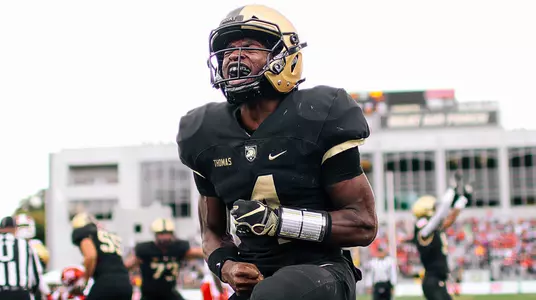
But he was just too sore to play against Miami and Coach Jeff Monken decided to go with sophomore Cam Thomas over senior Luke Langdon at quarterback. Thomas had looked impressive in the fourth quarter against San Jose State—albeit in a game long-decided—with 74 yards on seven carries. Monken and his coaches liked his speed and had been impressed with his decision-making ability in the triple option when he got reps in practice.
For most of the first half, Thomas and the offense were pretty close to perfect. The opening drive went 54 yards in 12 plays and took almost seven minutes off the clock before Darnell Woolfolk plowed in from the two yard line for a 7-0 lead.
Naturally, there was a fourth down pickup along the way: Thomas running right for seven yards on a 4th-and-2 at the Miami 46. That made Army 20-of-22 on fourth downs this season, a mind-blowing statistic.
Miami pieced together a drive, but the defense dug in and, when quarterback Gus Ragland was flushed out of the pocket on 4th-and-13 at the Army 34, he was stopped five yards shy of the first down. Ragland scrambling would become an important part of the storyline before the day was over, but early on, the defense got that key stop.
From there, the offense went 74 yards in 15 plays, killing 8:30 on the clock to an Andy Davidson run from 11 yards out soon after Kell Walker had picked up the obligatory fourth down with a 9-yard scamper on 4th-and-5 from the Miami 26.
All was well inside Michie Stadium. It was 14-0, the offense hadn't missed a beat with Thomas at the controls and the defense, as usual was making plays when it had to make them.
But it didn't stay that way. Miami returned the ensuing kickoff almost to midfield and, four plays after that, Ragland found running back Kenny Young wide open on a wheel route down the right sideline and it was 14-7.
Hardly reason to panic though, especially when the offense began yet another march, taking the clock down along the way. The drive, which lasted 15 plays, was almost identical to the one at the end of the first half out West that culminated with 12 seconds left in the half, gave the Black Knights a 14-3 lead and pretty much snuffed any remaining life out of the San Jose State.
ALMOST being the key word.
Army had a first down at the five yard line and Miami coach Chuck Martin—Monken's teammate almost 30 years ago at Division III Millikin (Illinois) University—gave up calling time outs to try to get an extra possession.
Instead, he watched his defense dig in and do something almost no one has done to Army all season—get a goal-line stop.
Woolfolk—who had run for Army's third fourth down conversion of the game earlier in the drive—picked up two. Then Thomas got nothing. Woolfolk almost got in on third down, stopped perhaps a foot short.
Monken called time out with six seconds left. Everyone knew Woolfolk was getting the ball—and he did. But for once, the powerful fullback couldn't push forward, stopped by Miami linebacker Brad Koenig, who got penetration, and, with help from his friends, kept Woolfolk just short.
Koenig had an extraordinary game. He was involved in 23 tackles and seemed to be everywhere on the field, even when double-teamed by Army blockers.
That stunning stop was the first time things began to feel uncomfortable. Miami raced to the locker room, still trailing 14-7 but with a huge adrenaline and confidence boost. Monken was fuming when he did his halftime interview with Tony Morino on Army's radio network. Maybe he also sensed that trouble was ahead.
And yet, for a long time in the second half, it seemed all was well. The defenses controlled most of the third quarter until Thomas broke free for a 52-yard run on Army's third possession to set up a first down at the Miami 24.
The Black Knights went back to triple-option basics from there—the fullbacks getting the next five carries: three by Woolfolk, two by Davidson—who ran most of the day much as he did prior to his injury two season ago.
Thomas, who would finish with 137 yards rushing, capped the drive with a sprint to the right and it was 21-7 as the third quarter ended.
Everyone breathed a sigh of relief.
They breathed an even bigger sigh when Miami, after twice converting fourth downs during its next drive, was stopped at the Army 22 on yet another fourth down and Army took over with 8:27 left and a two-touchdown lead.
As it turned out that was the last fourth down Miami failed to convert. The Black Knights were missing safety James Gibson who has often been their big-play guy at clutch moments the last two years and there was no doubt he was missed.
At that moment though, all that was needed were a couple of clock-killing first downs and the Black Knights would be 5-2 and have their 10th-straight victory at Michie.
Except it didn't happen. In fact, Army didn't get another first down in regulation. After a three-and-out, Miami took over at its own 32 and needed under two minutes to score on a fade pattern from Ragland to 6-foot-4 inch Dominique Robinson. That came one play after Ragland found Jalen Walker for 12 yards on 4th-and-9 from the Army 15.
That play began an avalanche of fourth down conversions for Miami that felt like water torture … drip, drip, drip …
It was still 21-14 and there was only 4:22 left. One first down was probably all that was needed—except Army didn't come close, even after recovering an onside kick at the 47 yard line.
Miami took over at its 18 with 3:28 left and began grinding downfield—picking up another fourth down before facing fourth down from the five yard line with 21 seconds left. After everyone in the stadium seemed to take a time out, Ragland found tight end Nate Becker wide open in the end zone off a neat play-fake and it was 21-20.
But Becker made one of those mistakes good teams don't make—slamming the ball to the turf and drawing an unsportsmanlike penalty that wiped out Martin's plan to go for two and try to win the game right there. Sam Sloman made the extra point from 36 yards away and it was 21-21.
Overtime.
Miami had all the momentum. The stadium was quiet.
But the defense got a stop—aided perhaps by Martin NOT going for 4th-and-11 from the 15 and instead settling for a Sloman field goal to make it 24-21.
Army had to get the offense going or the game would be over. Thomas picked up a first down at the 13, but then the Black Knights went backward: loss of one; loss of one; delay-of-game penalty. On 3rd-and-17, Thomas, who had thrown ONE pass all day very nearly hit Cam Harrison for the game winner.
But Miami's Travion Banks, who appeared to bump Harrison just before the ball arrived, got a hand on it and it bounded away. So close and yet…
The game was now on Abercrombie's foot. Miami (naturally) called time out to ice him. It didn't work—the kick knuckled through: 24-24.
Getting the ball first in the second overtime, Army finally got to the end zone. Aided by a blatent face-mask penalty on safety Bart Baratti, the Black Knights had first down just inside the 7. Woolfolk (22 carries, 96 yards) blasted up the middle and NO ONE was going to stop him this time—not even Koenig.
Army led 31-24.
Once again, it came down to fourth down, this time a 4th-and-15 from the 18 yard line after an Elijah Riley sack and a delay-of-game penalty had pushed the RedHawks back.
Didn't matter. Ragland, with time, threw a laser to Luke Mayock in the corner of the end zone for his team's SEVENTH fourth down conversion of the game, and it was 31-30.
Martin went for two—figuring, no doubt that if his team scored first in the third overtime it would have to go for two anyway. Plus, his team had converted every key play for about an hour at that point.
This time though, the Black Knights blew up the play. Ragland was going down—the game was finally going to be over!—but somehow just before he hit the ground, he flipped the ball desperately to his right to Young, who caught it in space and began flying toward the goal line.
At the two yard line he was hit by 5-foot-8 inch sophomore Javhari Bourdeau, who had just come into the game when Mike Reynolds was shaken up on Miami's third down play. Bourdeau slowed Young and Riley came in and finished the tackle and—AT LAST—the game.
It was as enervating and exhilarating a victory as you can possibly imagine.
Both Hopkins and Gibson are expected to be back for the trip next Saturday to Eastern Michigan. Escaping with this victory without them was remarkable.
The win also made Monken's record at Army 29-28. The last time he was over .500 was after his debut victory over Buffalo in 2014 made him 1-0. It's been a long journey from the nadir of 6-18 after two seasons here.
Which makes Saturday's long journey that much sweeter. Which is as it should be.