
Army West Point Athletics
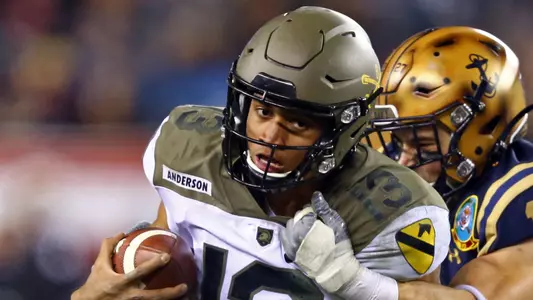
Photo by: Danny Wild-USA TODAY Sports
Feinstein's Findings: A Season to Learn From
December 16, 2019 | Football
PHILADELPHIA - In a very real sense, what happened here on Saturday wasn't at all surprising. Former Army Coach Bob Sutton used to always tell his players that, "The more desperate team wins the Army-Navy game." Sutton was 6-3 against Navy. He knew what he was talking about.
There was no doubt who the more desperate team was on Saturday. It didn't hurt that the same team also had the best player on the field—Malcolm Perry. One team was trying to salvage something from a disappointing season. The other knew that if it didn't win, all the gaudy numbers that went with a 9-2 record would feel pretty hollow.
There was no doubt who the more desperate team was on Saturday. It didn't hurt that the same team also had the best player on the field—Malcolm Perry. One team was trying to salvage something from a disappointing season. The other knew that if it didn't win, all the gaudy numbers that went with a 9-2 record would feel pretty hollow.
Army was hopeful; Navy was desperate. The result was a 31-7 rout in which more than half of the Black Knights' offense came on one first quarter drive.
Perry was magical. He ran the ball 29 times for 304 yards, consistently turning 5-yard runs into 15-yard runs and 15-yard runs into 40-yard runs. There were moments when he looked like a miniature Lamar Jackson with his jukes and cuts and ability to make tacklers reach for a uniform and end up grasping at air.
"I'm very glad Malcolm Perry is graduating," Army Coach Jeff Monken said when it was over.
That was an understatement.
Army didn't play poorly. In the first half, with Christian Anderson, who began the season as the third team quarterback, getting the first start of his career, the offense pieced together a near-perfect, 'Army,' drive. It lasted 10 minutes and 41 seconds and covered 78 yards in 18 plays; Anderson capping it with a 5-yard run. There was a fourth down that was picked up by inches. There were four converted third downs and Anderson carried nine times for 48 yards. He even completed a short pass to Cam Harrison.
It was textbook. It was exactly the formula Army was going to need to win the game: long, clock-eating drives that would not only pick up points but would keep Perry off the field.
Unfortunately for Army, that drive contained just about every highlight of the afternoon/evening—the lone exception being Jaylon McLinton's block of a Bijan Nichols field goal early in the third quarter.
Almost from the instant that David Cooper's extra point made it 7-0 Army with 27 seconds left in the first quarter, the rest of the day belonged to Navy.
It took the Mids four plays and 1:53 to tie the score. More accurately, it took PERRY four plays and 1:53. After losing a yard on the last play of the first quarter, Perry picked up 15 and then six and then 55—for the tieing touchdown. On the touchdown run, he appeared to be hemmed in shortly after crossing midfield, but made a jump-cut to get loose, burst to the sideline, got the one block he needed from fullback Jamale Carothers and was gone.
Then, Navy's defense got to work. Led by massive nose guard Jackson Pittman, who made life miserable for Navy's fullbacks when they tried to run between the tackles, they took the middle of the field away from the Army offense. With the linebackers and safeties playing directly across from the ball on virtually every play, Anderson's ability to get outside all but disappeared. After nine carries for 48 yards on the touchdown drive, he netted EIGHT yards on 12 carries the rest of the day.
Often, statistics can be deceiving. Not on this day. Navy ended up with 395 yards rushing—one-yard passing but it was a critical one—and Army finished with 172 yards, a grand total of 94 during the last three quarters, much of it in the fourth quarter when Navy dropped its linebackers into coverage with a big lead. Army's initial first down of the second half came with 10 minutes left—in the game.
Yes, it was exactly that bad.
In spite of all that, the Black Knights hung in for much of the second quarter. It was still 7-7 when Navy took over on its own nine with 4:42 left. The drive started slowly and, for a while it looked like the teams might go into halftime still tied or—worst case scenario—with the Mids up 10-7.
Perry was having none of it. With the clock under two minutes, Navy was still on its own 39-yard-line and only had one time out left. Perry dropped to pass, but had a better idea, taking off to his right, zigging-and-zagging down the field to the Army 17 before McLinton finally pushed him out-of-bounds.
On several occasions during the game, Perry dropped as if to pass. He was much-improved as a passer this season after Navy hired a passing-game coach to work almost exclusively with Perry. But when Perry surveyed the field and didn't see anyone open, or on occasion when he did, he took off and, as on the 44-yarder to the Army 17, the results were often spectacular.
Two plays later, facing third-and-five at the 12, Navy took its last time-out with 19 seconds left. A field goal appeared likely. But Perry got outside again and tip-toed down the sideline all the way to the one, before going out-of-bounds with 13 seconds left. If he'd stayed inbounds, the clock might have run out. But he didn't.
Niumatalolo had a choice: take the chip-shot field goal to guarantee the lead or take a chance by running one more play. It's worth remembering that both he and Monken once worked for Paul Johnson—Niutatalolo at Navy; Monken at Navy and Georgia Tech. No one gambled more often than Johnson, in large part because he honestly believed that EVERY play he called should go for a touchdown if executed properly.
That statement isn't a guess on my part; Johnson explained it to me years ago.
Both coaches inherited Johnson's riverboat gambler style.
And so, after Army called time-out, Niumatalolo ran a play he'd been saving for an important occasion—and this occasion was huge.
Perry took the snap and ran left with the entire Army defense (properly) in pursuit. But Perry flipped the ball back to Warren who was coming from the left and heading right. Before the Black Knights could try to string Warren out and keep him from the goal-line, he pulled up and tossed a high-lob in the corner of the end zone to wide receiver Chance Warren.
Carothers pulled the ball down with six seconds left for the touchdown as the Navy sideline went wild and the Army sideline slumped noticeably. It was a variation of the famous, "Philly Special," play the Eagles ran in the 2018 Super Bowl and it took place in an end zone where an Eagles logo could be seen underneath the Army logo because the rain had chipped away a good deal of the paint.
The play felt like a back-breaker at that moment and it turned out be exactly that. Navy raced to the locker room with a 14-7 lead and a clear belief it had control of the game. Army—as at the beginning—HOPED that wasn't the case.
Riley's block—an absolutely brilliant play on which he rushed wide and dove to get a hand on the ball—was Army's last real glimmer of hope four minutes into the third quarter.
But the offense, taking over on the 20, committed the first two penalties of the game (Navy didn't have one until a personal foul call in the last minute of the game after a last-chance interception) and moved back 13-yards. Zach Harding's punt was returned to the Army 45 and, from there, Navy made it look easy, taking seven plays to get into the end zone, Carothers capping the drive from 5-yards-out for a 21-7 lead.
That, in essence, was the ballgame. Army simply couldn't generate any offense and Navy kept grinding out yards and killing the clock. The Mids ran 56 plays—55 on the ground, the 'Philly Special,' the only pass of the day. Perry ran the ball 29 times; Carothers 22. Backup fullback Nelson Smith had three carries. The Navy slotbacks had ONE carry only because they didn't need to have any more than that; Perry and the fullbacks consistently picked up yards the last three quarters.
The most eloquent summation of the day came from Lieutenant General Darryl A. Williams, Army's Superintendent. As the last notes of 'Navy Blue-and-Gold,' died out, he found Niumatalolo, gave him a warm handshake and said, "Congratulations. You deserved this."
They did. A year ago, at the conclusion of Army's third straight victory over his team, Niumatalolo believed the Black Knights were clearly the better team. Even in defeat the previous two years, he believed his team was at least as good as Army's. Not last year.
He decided that was unacceptable. He told his long-time defensive coordinator Dale Pehrson that it was time for him to retire. He brought in Brian Newberry to replace Pehrson and when Newberry insisted on bringing some of his coaches from Kennesaw State, three more coaches were fired. Newberry installed a much more aggressive defense. Niumatalolo committed to Perry fulltime as his quarterback, after shifting him between quarterback and slotback for three years.
"What a moron I was," Niumatalolo half-joked Saturday night.
Navy did a complete 180 this season, going from 3-10 to 10-2 and was clearly the better team on Saturday.
For Army, it was a dismal ending to a dismal season, one that started with hopes of a third-straight double-digit win total. After a 3-1 September--the only loss in double-overtime at Michigan--things went south in October: four straight losses, two of them at home, after the Black Knights had won 15 straight at Michie Stadium, dating to November of 2016.
The injuries mounted up, including a critical one to quarterback Jabari Laws on what might have been a winning drive at Air Force. In essence, a targeting foul by an Air Force player might have saved the day for his team. Kelvin Hopkins Jr. came on, having been banged up all season, and couldn't finish the drive. That day was a microcosm of the season.
The final result was a 5-8 record and a resounding loss in the most important game of any year. The seniors who will graduate in the spring can walk away with heads held-high, having restored Army football to respectability—and then some. In all they had a record of 34-18, including 3-1 against Navy and back-to-back CIC's—a first in Army football history.
For Monken and his staff and those who will return, there's a lot of work to do this winter, spring and summer before Bucknell comes to Michie Stadium on September 4th.
Niumatalolo declared Saturday's victory THE most important of his 97 wins at Navy. "We needed to get back to dominating," he said.
You can bet Monken and company will read those words and vow not to let it happen again. Singing first is a lousy feeling. To put it mildly.


Players Mentioned

QB
/ Football
K
/ Football
P
/ Football
QB
/ Football
QB
/ FootballThis Week in Army Football: Navy
Tuesday, December 09
Army at UTSA Game Highlights
Sunday, November 30
This Week in Army Football: UTSA
Tuesday, November 25
This Week in Army Football: Tulsa
Tuesday, November 18