
Army West Point Athletics
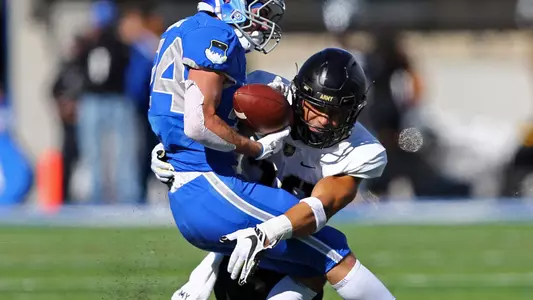
Photo by: Danny Wild/Army West Point
Feinstein's Findings: No Moral Victories
November 03, 2019 | Football
New York Times bestselling author, John Feinstein, is back for another season with the Black Knights and will report in after each football game during the 2019 season. Feinstein's weekly report will be posted to GoArmyWestPoint.com following each battle on the gridiron.
There are no moral victories in football, especially in games that involve the Commander-in-Chief's Trophy.
There are no moral victories in football, especially in games that involve the Commander-in-Chief's Trophy.
That's why Army's 17-13 loss to Air Force in Falcon Stadium on Saturday was so wrenching. The Black Knights played their best game since September and, for much of the day, were the better team. They could absolutely point to what appeared to be a critical missed call as arguably being the difference in the game. They made some brilliant plays. And, they made those who had made Air Force a 17-point favorite look foolish.
Yet, when it was all said and done, none of that mattered. As the great Jim Valvano used to say, "When the clock hits zero, a 'W,' is a 'W,' and an 'L,' is an 'L,'—no ifs ands or buts."
This was an extremely painful 'L,' if only because of what might have been.
This was a rock fight in pads, two teams desperately wanting to win for different reasons.
Army had suffered through a lost October, four straight losses marked by injuries and mistakes and wanted to turn the season around by beating its No. 2 rival for a third straight season. Air Force, once the dominant team in the CIC circle, had already lost its chance to win it back this season when it lost to Navy in the final seconds a month ago. The Falcons had bounced back with three impressive wins and badly wanted to make up for the 21-0 shellacking Army had put on them on their home field two years ago.
Two very motivated teams.
Army came out looking like the Army team that had gone 21-5 the last two seasons. Coach Jeff Monken decided to go with sophomore Jabari Laws at quarterback, in part because Kelvin Hopkins Jr, still wasn't 100 percent and hadn't practice during the week, in part because he thought that Laws' elusiveness might be important playing behind what was essentially a brand-new offensive line—four new starters.
On Army's third play from scrimmage, a third-down-and-four, fullback Sandon McCoy burst through a hole on the right side for 38-yards, taking the ball to the Air Force 30. Five plays later, the Black Knights had a first-and-goal on the Air Force six.
That's when things turned strange. On third down from the three, Army center Noah Knapp was called for a phantom hold, moving the ball back to the 13. As if to even things up, Air Force's Zane Lewis was then called for an equally phantom hold in the end zone—moving the ball back to the six with a new set of downs.
The Black Knights got the ball inside the one on three plays and—of course—Monken elected to go for the touchdown. As Army often does on very short yardage plays, fullback Connor Slomka lined up directly behind the quarterback and pushed Laws in the direction of the goal line as he took the snap.
Laws scored, his initial push taking the ball across the goal line.
Except the officials, in the mass of humanity pushing and shoving from both directions, missed it. Then the replay official decided it was too close to overturn—except it wasn't.
If you have read these weekly breakdowns the last several years you know I rarely bring up officiating. I might occasionally question a call, but I try very hard to be aware of my biases and stay away from questioning calls.
And, if I do bring up a call, I will almost always add, "but that call didn't decide the game."
One call almost never decides a game—ESPECIALLY a call in the first quarter. This call may not have decided the game either, but it was massive.
Instead of taking more than eight minutes off the clock to earn a 7-0 lead, Army walked away with nothing and Air Force was able to work its way almost to midfield before punting.
And, as it turned out, Air Force scored first on a 20-yard Jake Koehnke field goal with 8:08 left in the second quarter. The Falcons had moved the ball from their own 21 to the Army 5, but a false start penalty moved them back and they ended up settling for the field goal.
Army answered before halftime, going 65 yards in 11 plays and taking 6:51 off the clock—an extra benefit since it left Air Force with little time to respond before the break.
It was during this drive that Laws began to show off his arm, notably on a perfectly-timed, perfectly-thrown wheel route throw to Malik Hancock, who went down the right sideline to the Air Force six.
For better—and mostly worse—Army hasn't done anything easily this season. A false start by tackle Jaxson Deaton moved the ball back to the 11. Laws picked up three and then three more. Slomka drove for three, setting up fourth-and-goal at the two. Logic dictated that Monken should send Cole Talley in for a chip-shot field goal since coming away without points again would be devastating.
Monken is a man who doesn't rely much on logic. Yes, he listens to what the analytics people are telling him, but often he just goes with his gut. After a time out, he sent the offense back onto the field. Laws ran right, got a great seal block on the edge and scored easily. Fortunately, he ran so far into the end zone that the officials had no trouble deciding if he'd gotten in.
Army led 6-3 with 1:17 left in the half. But then Talley pushed the extra point wide right. Later, Monken would shake his head and say, "the two things that really killed us were not getting in from the four-inch line and the missed extra point."
He was right. Air Force almost got into field goal range but didn't quite get there and that was the halftime score.
The defenses dominated the first four possessions of the third quarter—both teams going three-and-out twice. But there were ominous signs. Army had rushed the ball on every play of the opening drive—picking up all 74-and-99-100ths of its yardage without a pass. But Air Force had made adjustments and the running game was going—essentially—nowhere as the game progressed. The Black Knights would finish with 129-yards rushing for the day.
And then, Air Force—which had almost no luck throwing the ball all day—began to pick up its running game, largely by running counter-plays that caught the Black Knights going the wrong way. Large chunks of the yardage were ripped off by fullback Timothy Jackson, who had rushed for more than 100 yards in each of Air Force's three wins coming into the game. He would finish with a career-high 155 yards and a touchdown on twenty carries—often charging to first downs on key third downs. In all, the Falcons ran the ball for 328-yards.
Jackson started a nine-play Air Force drive—all of it on the ground—with a 40-yard dash and then ended it with a three-yard touchdown run with 2:35 left in the third. Air Force led 10-6.
That lead lasted 13 seconds.
After Cade Barnard had been called for a personal foul on the kickoff—which was a touchback—Army started at it's own 12-and-a-half yard line. Monken had just finished blistering Barnard for yet another in a series of unforced errors that has plagued this team all fall, when Laws dropped and found Cam Harrison wide—WIDE—open down the middle. Harrison has excellent speed, but the case can be made that someone with MY speed might have scored once he caught the ball.
The Black Knights had the lead back, 13-10—Talley converting the extra point this time.
But Air Force's running game was now rolling. After Jackson had picked up eight-yards on two carries, quarterback Donald Hammond III took off on a 30-yard jaunt. Still, Army had a chance to hold Air Force to a Koehnke field goal when a false start put the Falcons in a third-and-ten at the 26. This time, Hammond simply handed off to Joshua Stoner and he picked up 16-yards off the right side. Two plays later, Stoner scored and it was 17-13, Falcons with 13:08 left to play.
It stayed that way until Army had one last chance to steal the game. It looked for a while as if Air Force might take the clock down to nothing or almost nothing when the Falcons used up 10 plays and almost six minutes of clock before the Army defense stiffened. A punt into the end zone gave the Black Knights the ball with 2:53 and two time outs left.
Doing a decent imitation of an NFL quarterback running a two-minute drill, Laws quickly moved his team downfield. On a third-and-eight, he found Artice Hobbs IV for 15-yards. Then he hit Kjetil Cline for five-yards, stepping out-of-bounds and ran a quarterback draw to midfield for another first down. A strike to Harrison put the ball on the Air Force 39.
Then, after another unforced error—a false start by McCoy—Laws threw what might have been his best pass of the day, feathering the ball over defenders into the hands of Brandon Walters, who was dragged down at the 14.
That also turned out to be the last pass Laws would throw. He was hammered, helmet-to-helmet on the play by Air Force defensive end Jordan Jackson. Somehow, the officials missed the play on the field. When Laws—5-foot-9 and 172 pounds—didn't get up after being hit in the head by Jackson—6-foot-5 and 270 pounds, it occurred to someone to take a look to see if a targeting foul was merited.
It was and the ball was moved to the seven-yard line. But the play benefitted Air Force: it knocked the red-hot Laws out of the game and gave its tired defense a breather while the replay was going on.
Hopkins came on, completely cold, certainly not expecting to get into the game at that moment. That's not an excuse—he needs none—it's just a fact.
Hoping for a surprise, Army called play-action on first down, but the Falcons didn't bite and Hopkins had to throw the ball away. Hopkins picked up two-yards on second down. Then Hopkins tried to throw a fade in the corner to Harrison, but it was well-covered.
Fourth down.
Hopkins dropped and, if he had looked to his right, would have seen Kell Walker wide open in the flat. But he didn't see him and threw incomplete into the end zone.
"It was open in the flat," Monken said. "I wish we'd gotten the ball there. It was wide open."
Walker never touched the ball all day, Air Force keying its defense on denying him the ball. If he had touched it once, Army would have won.
But he didn't and, as Valvano would say, the result was another, 'L.'
Which leaves Army's season exactly here: Four games left, the next two at home against Massachusetts and VMI, teams that should provide a tonic for the five-game losing streak. Army will then have to win on the road at Hawaii and in Philadelphia against Navy to have a chance to go to a fourth straight bowl game. If the Black Knights can beat the Midshipmen—who are now 7-1--they would retain the Commander-in-Chief's Trophy. That would be a season-saver.
Monken was asked as he wrapped up his postgame press conference what he had said to his players in the locker room. "I told them I was proud of the effort," he said. "They played hard." Then he paused and added. "Not really any words to say. It was disappointing."
There really weren't any words to say. There's no plane flight longer than the one home from Air Force after a loss. Some 'L's, hurt more than other 'L's.'


Players Mentioned

RB
/ Football
WR
/ Football
OL
/ Football
RB
/ Football
RB
/ Football
OL
/ Football
QB
/ Football
RB
/ Football
RB
/ Football
K
/ Football
RB
/ Football
RB
/ FootballThis Week in Army Football: Navy
Tuesday, December 09
Army at UTSA Game Highlights
Sunday, November 30
This Week in Army Football: UTSA
Tuesday, November 25
This Week in Army Football: Tulsa
Tuesday, November 18