
Army West Point Athletics
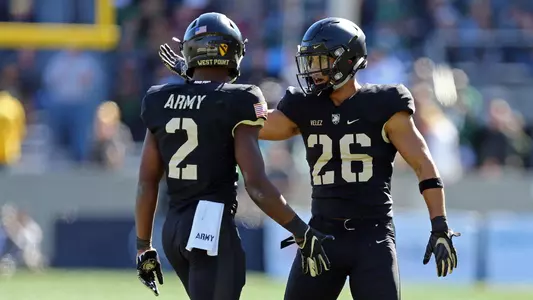
Photo by: Danny Wild-USA TODAY Sports
Feinstein's Findings: Army Ran into a Good Team
October 06, 2019 | Football
New York Times bestselling author, John Feinstein, is back for another season with the Black Knights and will report in after each football game during the 2019 season. Feinstein's weekly report will be posted to GoArmyWestPoint.com following each battle on the gridiron.
WEST POINT, N.Y. - It is a given that football coaches spend the week leading up to a game talking about their next opponent as if Bronco Nagurski and Dick Butkus will be reborn for one Saturday and the opposition will resemble the old Green Bay Packers bolstered by today's New England Patriots.
WEST POINT, N.Y. - It is a given that football coaches spend the week leading up to a game talking about their next opponent as if Bronco Nagurski and Dick Butkus will be reborn for one Saturday and the opposition will resemble the old Green Bay Packers bolstered by today's New England Patriots.
But when Army football coach Jeff Monken said last week that Tulane was the best team the Black Knights had faced all season, I believed him. "They may not have as much talent as Michigan," Monken said. "But I think they're the best TEAM."
As it turned out, Monken knew what he was talking about. Tulane, which is now 4-1 after beating Army 42-33 inside sold-out Michie Stadium on Saturday, is very experienced on both sides of the ball, very well-coached and, in the last three years has learned the art of winning football games.
Army hadn't lost a game at Michie since the Saturday prior to the 2016 election—15 straight wins. If that bothered the Green Wave, it didn't show. On Tulane's first play of the game, quarterback Justin McMillan fumbled, Army recovered and, two plays later—less than 90 seconds into the game, Army led 7-0 after Connor Slomka plowed into the end zone from two-yards out.
Tulane's response? Touchdown drives the next three times it had the ball to take a 21-7 lead. If there was any doubt that Monken wasn't kidding about how good the homecoming opponent was, it was long gone by the middle of the second quarter.
Monken, whose postgame honesty—win or lose—often makes him an outlier among college football coaches, summed up the long day well when it was over: "They rushed the ball for 324 yards, we rushed it for 193. We're a team that's built on running the ball and stopping the run. We didn't do either today."
Tulane averaged 6.1 yards a carry and ran the ball into the end zone five times. As Monken noted, that's not going to get the job done. Army averaged 4.4 yards per carry—which isn't awful—but wasn't nearly good enough.
The best news of the day for Army was the return of quarterback Kelvin Hopkins Jr. after he'd missed all but one snap of the last two games with a sprained knee. Hopkins played well: he rushed the ball 24 times for 132 yards and two touchdowns. At times, he threw the ball well, completing nine passes for 170 yards and a touchdown, but he was nine-of-24 overall and also threw an interception.
But in the end, in spite of causing two turnovers, it was the defense that struggled—a defense that had given up just 16 points a game in the season's first four games. This though, was an opponent of a higher quality. The Green Wave finished with 525 yards in total offense, not to mention the six touchdowns.
Quarterback McMillan fumbled twice—early and late, the second one leading to a 54-yard Jabari Moore recovery and touchdown—but in-between he was brilliant. Whenever Army DID stop the run, McMillan found a way to pick up a key third down with his arm. He completed 15-of-21 passes for 201 yards and a touchdown. Both of McMillan's parents are in the Army. He spent three years at LSU, playing little, then transferred to Tulane. A year ago, he took over as the starter when the team was 2-5 and the Green Wave went 5-1 the rest of the way. He's now 9-2 as a starter.
McMillan had plenty of help though, notably from a huge offensive line that consistently opened holes for Tulane's running backs—and from an Army defense that had trouble finishing tackles too often. There was also Amare Jones, who ran the ball nine times for 65 yards and a touchdown AND caught six passes for 104 yards and another touchdown. The Green Wave had a lot of weapons and they used them all throughout the game.
All of that said, Army could have won the game. After Tulane had driven the ball 82 yards; 84 yards and 90 yards to take that 21-7 lead, the Black Knights responded. They put together a 77-yard 15 play drive of their own, capped by a one-yard Hopkins run to made it 21-14 with 4:26 left before halftime.
Then the defense finally got a stop and Army had a chance to get closer or perhaps even tie the score before the break. But a drive that started at the Army 29—and included Hopkins picking up four yards on a fourth-and-one—fizzled when Hopkins was sacked on a fourth-and-seven from the Tulane 36. So, it was 21-14 at halftime—with Army getting the ball to start the second half.
College football halftimes last 20 minutes nowadays so the term, 'momentum,' rarely applies by the time the teams return from the locker room. But the Black Knights clearly appeared to have it when they swept right down the field to start the third quarter, needing just seven plays to go 75 yards. Hopkins again capped the drive, this time with a four-yard-run. Just like that, the score was tied 21-21, the place was jumping and it looked like another edition of 'Michie Magic,' might be in store.
Tulane, however, was unshaken. The Green Wave responded with yet another long drive—10 plays, 77 yards--climaxed by a 13-yard Darius Bradwell run on a third-and-three when the defense was looking pass and Tulane Coach Willie Fritz called a run. It was 28-21.
Soon after came what might have been the key moment in the game. On a third-and-five at the Army 30, Hopkins was stopped for no gain. On came the punt team. Twice this season, Army has been burned by fake punts. This time though, the Black Knights turned the tables. Defensive captain Cole Christiansen took the snap and raced 31-yards down the left side to a first down at the Tulane 39. A huge play.
Except it got called back by what appeared to be a questionable holding call on Ryan Velez, blocking on the edge on special teams. Am I biased in saying the call was questionable? Absolutely. But in the Navy press box, where the Midshipmen were about to play Air Force, longtime Navy SID Scott Strasemeier watched the replay and said, "that sure didn't look like a hold to me."
Strasemeier is also biased—the other way.
The Black Knights had to punt for real after the penalty and, after another exchange of punts, the game got out-of-hand. The Green Wave AGAIN went the length of the field (12 plays, 78 yards) the key play of the drive coming on the second play of the fourth quarter when McMillan found Darnell Mooney for 19-yards on a third-and-seven from his own 25.
Desperately needing a big play, Army got one when Artice Hobbs IV returned the kickoff 46-yards to the Tulane 30. But the offense sputtered, going backwards and turning the ball over on downs four plays later. Tulane only needed five plays to punch the margin to 42-21, the touchdown coming on a 41-yard McMillan to Cameron Carroll pass with 5:46 to play.
The game was over. Except, someone forgot to tell the Army players it was over. They hung in, Hopkins picking up a first down on fourth-and-ten and then, on the next play, finding Cam Harrison for an 11-yard touchdown to cut the margin to 42-27.
Army onside kicked. Tulane recovered. But then McMillan put the ball on the ground for the second time and Moore took it to the end zone. After a failed two-point attempt, it left the margin at 42-33 and, even though the defense did force a punt, Army's last desperate drive was moot, because the margin was nine.
When all was said and done, the late rally was admirable, but the better team won the game. Army's offense might have had its best game of the season and having Hopkins back clearly provided a boost. But the defense simply couldn't find a way to consistently stop the Green Wave. Speed kills and, on Saturday, it killed the Black Knights.
And so, what looked like a difficult five-week stretch before it began, started with a loss. The Black Knights are now 3-2 heading into back-to-back road games at Western Kentucky and Georgia State. The Hilltoppers are also 3-2, having won Saturday at Old Dominion—a team that led Virginia 17-0 at one point.
Road games are never easy. The next two will not be easy. Then comes a home game against a much-improved San Jose State team—also 3-2, including a win at Arkansas—and then the trip to Air Force. The schedule that so many scoffed at in August is looking a lot tougher now that everyone is actually playing football.
The Black Knights got punched in the mouth Saturday by a very good football team. They stayed on their feet and ended up losing by decision. That was the encouraging part. Now, they have to find a way to improve enough on both sides of the ball to deliver some blows of their own the next four weeks.


Players Mentioned

LB
/ Football
RB
/ Football
QB
/ Football
DB
/ Football
RB
/ Football
DB
/ FootballThis Week in Army Football: Navy
Tuesday, December 09
Army at UTSA Game Highlights
Sunday, November 30
This Week in Army Football: UTSA
Tuesday, November 25
This Week in Army Football: Tulsa
Tuesday, November 18