
Army West Point Athletics
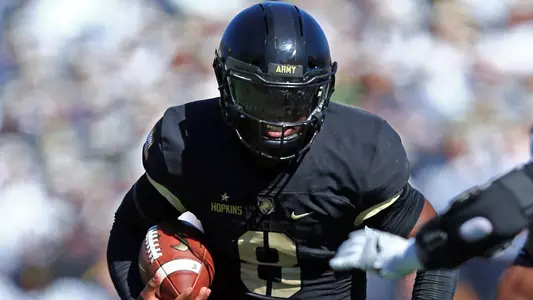
Photo by: Danny Wild-USA TODAY Sports
Feinstein's Findings: Time for the Black Knights to be the Black Knights
October 13, 2019 | Football
WEST POINT, N.Y. - They say that statistics are for losers—and, even in today's stats-obsessed world, they're right most of the time.
But one statistic from Western Kentucky's 17-8 win over Army on Saturday night tells a shocking story about this game and—in many ways—about Army's season to date: 38:07 to 21:53.
But one statistic from Western Kentucky's 17-8 win over Army on Saturday night tells a shocking story about this game and—in many ways—about Army's season to date: 38:07 to 21:53.
That was the game's time of possession. Numbers like that are certainly not unfamiliar to the Black Knights—except for this: the team with the dominant number—in this case 38:07—is supposed to be Army. On Saturday, the home team, the Hilltoppers, had that number and it was an absolute microcosm of the game itself.
Army had four possessions in the first half. The results were: punt, punt, punt, punt. If you're looking at the glass half-full, the good news was that there were no turnovers and a late defensive stand kept the halftime deficit to 7-0, certainly a manageable margin.
Except, the second half wasn't much better, although Army was able to finally move the ball on a couple of occasions. The most crucial moment came on a drive that began late in the third quarter and stretched into the fourth. After Western Kentucky had extended the lead to 10-0 with a 15-play drive that ended on the Army three-yard-line, the Black Knights, for the first time all night, got their offense in gear.
The key play was a 31-yard Kelvin Hopkins Jr. to Artice Hobbs IV completion that moved the ball to the Western Kentucky 29-yard-line. From there, five straight running plays put the ball on the Hilltoppers four-yard-line, first down. There was still almost a quarter to play. If Army could punch the ball in to make the score 10-7 it would have momentum and—perhaps—a tiring Western Kentucky defense. Army's defense had been solid most of the night, so there was reason to hope…
It went away in four plays: Hopkins was stopped for no-gain. Then he was trapped for a three-yard-loss. The last thing Army needs at any point in the game is third-and-seven, but it is especially daunting inside the 10-yard-line. Hopkins tried to find Kjetil Cline in the end zone, but the pass was broken up. The smart thing to do at that moment was send David Cooper in to kick a 24-yard field goal and at least make it a one score game.
Cooper had made both his field goal attempts since becoming the team's placekicker in the Texas-San Antonio game. But he missed this time and one could almost feel the air go out of the Army sideline even from 674 miles away—the distance from my house to L.T Smith Stadium in Bowling Green, Kentucky.
In theory, the game wasn't over. There were still almost 14 minutes left to play. A turnover, a three-and-out, an Army drive that culminated in a score and…
Except that Western Kentucky was having none of that. The Hilltoppers (again) did to Army what the Black Knights have done to opponents in recent years: they put together a 14-play 80-yard drive that took 9:25 off the clock. By the time quarterback Ty Story charged into the end zone, the game clock was down to 4:02 and that score made the margin 17-0.
Watching that drive, reminded me of listening to a North Carolina-Wake Forest basketball game more than 35 years ago. This was before there was a shot clock in basketball and UNC Coach Dean Smith had perfected the art of killing the clock with an offense called, 'The Four Corners.' His point guard would dribble the ball in the middle of the floor and when a defender tried to double-team, the guard would flip the ball to one of his teammates and then go get it back. The great Phil Ford was the maestro of the Four Corners.
But on this night, Wake Forest had the lead and a superb point guard named Frank Johnson. Wake Coach Carl Tacy put Johnson in the middle of the Four Corners and melted the clock down. Watching, Woody Durham, UNC's iconic radio play-by-play man finally said: "This is like getting shot with your own gun."
That's the way Western Kentucky's final touchdown drive felt. The Hilltoppers kept moving the ball downfield ever so SLOWLY, picking up four-yards here; six there; five more after that. The only difference between this drive and an Army drive was that Storey mixed in some passes—five in all—but none was for more than seven-yards and all were complete and kept the clock running. Four times, WKU faced third-down, four times the Hilltoppers converted.
After that, the only question remaining was whether Army would avoid being shut out for the first time since ---- . Fortunately, the Black Knights did that, putting together a 75-yard drive that was climaxed by a Hopkins to Malik Hancock eight-yard touchdown pass with 1:41 to go. Hancock's two-point conversion made the final 17-8, which made this one of those games where the game wasn't as close as the final score indicated.
Sadly, the other stat that has to be noted was Army's 137 yards rushing. The Black Knights have occasionally had QUARTERS under Coach Jeff Monken in which they rushed for close to that total. Going into the game, there wasn't any doubt that the Hilltoppers had a good defense—they were giving up a little more than 20 points per game and had returned their TEN leading tacklers from last season.
Still, no one expects to see Army's running game completely bottled up for four quarters. The average per carry was 3.6 yards and the number was only that high because Hobbs had 20 yards on his three carries. One other number worth throwing in: Army was three-of-11 converting third downs, WKU 10-of-17, bolstered by that four-for-four on the last drive.
In the end, the only numbers that matter are 17 and 8 and 3-3, which is now Army's record for the season.
Everyone knew that October was going to be more difficult than September, that the opponents—Michigan aside—were going to be a lot tougher than those faced in the season's first month.
It is both unfair and hyperbolic to say that a season is in crisis when only six of 13 games have been played. The most important goals are still out there: winning a third straight Commander-in-Chiefs Trophy and going to a fourth straight bowl game.
It is clear that the CIC is going to be a tougher task this season than last. Navy, which won a superb game a week ago against Air Force, is now 4-1 after routing Tulsa (at Tulsa) Saturday night. Air Force is 4-2, in spite of the loss to Navy, and dominated Fresno State in the second half on Saturday.
Both teams are clearly better than a year ago and Army has to go to Falcon Stadium the first Saturday in November—a place where it has won twice since 1977, although the second time was two years ago.
Then there is the bowl, which seemed like a foregone conclusion before the season began. The Black Knights will need three more wins in six games to get to six wins. The November VMI game can't count towards that number because Army already has an FCS win—Morgan State—and only one can count towards bowl eligibility.
So, that leaves next Saturday night's game against Georgia State (which is 4-2 including a win at Tennessee); home against San Jose State (which is 3-3 and has a win at Arkansas); at Air Force; home to Massachusetts; on the road against Hawaii and then, of course, Army-Navy.
There is still plenty of room for improvement—especially on the offensive side of the football. But the time for talking about the team's potential is now past.
The Black Knights need to find the Black Knights—turn the gun back on the opposition.


Players Mentioned

WR
/ Football
K
/ Football
RB
/ Football
RB
/ Football
QB
/ FootballArmy Hockey Ivey Bros Feature
Monday, December 22
This Week in Army Football: Navy
Tuesday, December 09
Army at UTSA Game Highlights
Sunday, November 30
This Week in Army Football: UTSA
Tuesday, November 25