Army West Point Athletics
Feinstein's Findings: No Moral Victories, But...
September 23, 2018 | Football
New York Times bestselling author, John Feinstein, is back for another season with the Black Knights and will report in after each football game during the 2018 season. Feinstein's weekly report will be posted to GoArmyWestPoint.com following each battle on the gridiron.
To quote my children: OMG!
In old man talk that means, "Oh My God!" How else do you even begin a conversation about what happened in Norman, Okla., on Saturday night? Or, more accurately, what almost happened.
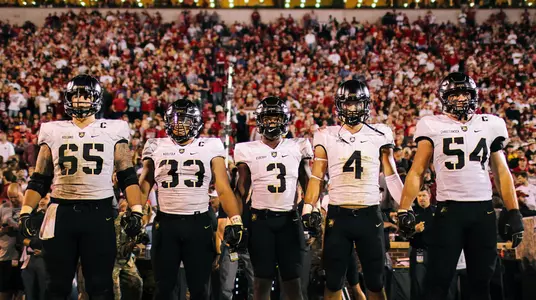
The Black Knights walked into Memorial Stadium and nearly gave over 87,000 fans—not to mention the entire world of college football—the shock of their lives. Fifth-ranked Oklahoma survived, and I do mean survived, 28-21—in overtime.
When their collective heart started beating again, the red-clad Oklahoma fans gave the Black Knights a standing ovation as they left the field. They knew what had almost just happened.
For most of us, a realistic goal for Army going into this game was to come out of it without any significant injuries and feeling as if the game had been competitive.
Win? Beat a top ten team for the first time in more than 50 years? There was only one place where that thought crossed anyone's mind: the Army locker room.
What is often difficult to understand for those of us who don't put on a uniform is that players crave this kind of game. Jim Cantelupe, Army's defensive captain in 1995 may have explained it best: "If you can't play FOR Notre Dame," he said, "the next best thing is to play AGAINST Notre Dame."
That Army team did play against Notre Dame and missed beating the Irish—still a perennial (rather than occasional) national power back then—by a foot. Army scored in the last minute to make the score 28-27. That was the last college football season with no overtime and coach Bob Sutton went for two and for the win even though he was in the final year of his contract and a tie with the Irish might have guaranteed an extension.
"We didn't go there to tie Notre Dame," said Sutton, who got a new contract and led Army to a 10-2 record a year later. "We went there to beat Notre Dame. None of the players would have ever spoken to me again if I'd kicked the extra point."
Quarterback Ronnie McAda found tight end Ron Leshinski in the flat and Leshinski was pushed out-of-bounds a foot short of one of the great upsets in college football history.
Saturday night, Army's players got to play AGAINST Oklahoma, a team that was 11-2 a year ago and lost a memorable Rose Bowl game in overtime to Georgia in the College Football Playoff semifinals.
That team was led by Heisman Trophy winner (and No. 1 NFL draft pick) Baker Mayfield. His replacement at quarterback this season is Kyler Murray and the Sooners haven't missed a beat. In fact, Murray's statistics in OU's first three games were virtually identical to Mayfield's a year ago.
And, unlike a lot of college powers, the Sooners didn't open their season against Cupcake U. They routed Florida Atlantic, a team that won 11 games last season; they easily beat UCLA under new coach Chip Kelly and they avenged their one regular season loss of a year ago by going to Iowa State a week ago and winning.
In short, this Oklahoma team may be just as good or better than last year's Oklahoma team.
Which should have been pretty scary for the Black Knights. A week earlier they had faced a Hawai'i team that came in averaging 48 points a game. Oklahoma was averaging 49.
Hawai'i is good and Army's 28-21 victory was a big deal for a still-developing team with a quarterback making just his third career start. But Oklahoma is, well, Oklahoma. And this game wasn't in the friendly confines of Michie Stadium.
Sure enough, Murray and OU needed just six plays to go 68 yards for a touchdown to open the game—much like Hawai'i, which needed only five plays to go 75 yards.
But Army then proceeded to do what it absolutely had to do to make it a ballgame: it began grinding out yards, killing clock and moving the ball. To the dismay of the Oklahoma faithful, the offense ran 16 plays and took more than nine minutes off the clock before Connor Slomka plowed in from the 1-yard line to make it 7-7.
The Sooners promptly—and I do mean promptly—responded: six plays again, this time to go 65 yards. And, Army answered as it needed to: 16 more plays, 8:54 with the ball and Kelvin Hopkins Jr. scoring on a pretty 5-yard run to tie the game at 14-14.
Oklahoma only needed FOUR plays on its third possession, Murray racing 33 yards to make it 21-14. Murray is a superb athlete who is as dangerous with his legs as his arms. He was the ninth-pick in the Major League Baseball draft this past June and has already signed with the Oakland Athletics for a $5 million bonus. He's that good.
Army couldn't answer the third Oklahoma touchdown, but the defense rose up after Zach Potter had pinned the Sooners at the 7-yard line. A personal foul penalty moved the ball to the 22 and a two score OU lead at halftime seemed entirely possible. But James Nachtigal sacked Murray and forced a punt. Even though Army got the crucial stop, two critical penalties made just enough of a difference in field position to keep the Black Knights from getting into field goal range before time expired.
Still, trailing 21-14 at halftime felt pretty good. Coach Jeff Monken's message in the locker room had to be pretty direct: we can play with these guys.
There are, of course, college football games where a huge underdog (four touchdowns in this case) hangs with the favorite for a half and then the team filled with future NFL players gets its act together during the break and turns the game into a blowout. A year ago, Army trailed Ohio State 17-7 after 30 minutes before losing, 38-7.
Not this time. After a disappointing three-and-out for the offense, Mike Reynolds' interception at the Army 15 ended Oklahoma's first drive of the second half and then the offense went back to work.
On both touchdown drives in the first half, Army had converted fourth downs—one on the first drive, two on the second. Clearly Monken understood that, in a game like this, there were going to be risk/reward moments. He never backed off from the risks—and was rewarded.
On the second drive, the Black Knights went for a 4th-and-1 from their own 34 (!!) and Jordan Asberry picked up 14 yards. On a 4th-and-8 from the OU 37, Hopkins found Kell Walker for 13 yards and another first down.
A word here about Walker—who didn't touch the ball once in the Hawai'i game. His importance to this team as the season goes on was never more evident than on Saturday. Clearly, Monken and offensive coordinator Brent Davis made it a priority to get him involved in this game and it paid off in spades: 12 carries for 80 yards; three catches for 40 more.
After the Reynolds interception, Army began another lengthy drive. Once again, the Black Knights faced a fourth down and, once again, went for it. This time, from the Oklahoma 25, Hopkins picked up five on 4th-and-1. Four plays later, Andy Davidson ran in untouched from the 3-yard line and the game was tied once more at 21-21. Another textbook drive: 19 plays and 10:47.
Both teams had chances in the fourth quarter. Army moved to the OU 34 and seemed to be in position to perhaps win the game with a late field goal. But Hopkins was hit and intercepted on a 3rd-and-12. Like lightning, the Sooners moved into field goal position but their kicker, Austin Seibert, missed from 33 yards at the buzzer.
Overtime.
Think about that: OVERTIME, against a team that may have a shot to win the national championship.
Seeming to understand that their margin for error was completely used up, the Sooners scored quickly, Murray finding CeeDee Lamb from the 10 yard line on the second play to make it 28-21.
This was where the notion of needing a perfect game to win came into play. After Darnell Woolfolk, who again ran hard up the middle all night, picked up three yards, the Black Knights lost five yards on a false start penalty. On a trick play Fred Cooper threw incomplete to Walker, then Calen Holt picked up five to make it 4th-and-7. On fourth down, the Sooners blitzed and Hopkins had to throw the ball up and pray. The prayer wasn't answered. Parnell Motley intercepted at the 2-yard line and it was over.
There are no moral victories in football, but there is reason to feel proud of an extraordinary effort and that was certainly the case on what almost became an historic Saturday night in Norman.
That said, it is vital that the players shrug off all the backslaps they will receive all week around post and in the barracks because an heroic loss can easily become two losses in college football.
Saturday's opponent is Buffalo, which is 4-0 and just destroyed Rutgers—a bad Big Ten team but still a Big Ten team—42-13 on Saturday. The Bulls beat Army in overtime two years ago and the Black Knights had to rally to win at home last year.
Their coach, Lance Leipold is much like Monken in that he has engineered a remarkable turnaround. He was 89-6 (that's not a typo) in eight seasons at Division III Wisconsin-Whitewater winning six national titles. Now, in his fourth season at Buffalo, he has built a winning program and, with the game at Buffalo, it will take a supreme effort to walk away with a win.
The effort this past Saturday was close to superhuman. Army's got to continue producing that sort of effort to get where it wants to go this season.
All of that said: OMG!