
Army West Point Athletics
Feinstein's Findings: Michie Miracles Continue
November 04, 2018 | Football
New York Times bestselling author, John Feinstein, is back for another season with the Black Knights and will report in after each football game during the 2018 season. Feinstein's weekly report will be posted to GoArmyWestPoint.com following each battle on the gridiron.
It may be time to give a name to the heart-stopping football games that have defined Army's 11-game winning streak at home that now dates back two years.
How about, "Michie Miracles?"
The description might not be perfect, but the alliteration certainly works.
It isn't as if every game in the current string has come down to the final play, but it certainly feels that way.
It certainly felt that way Saturday after Air Force had closed from a 14-0 halftime deficit to 17-14 and got the ball back with plenty of time left in the game.
Sure enough, the Falcons were rapidly closing in on field goal range—at least. Quarterback Donald Hammond III, who came in at halftime to spark the Falcons offense, quickly found Geraud Sanders down the seam for 19 yards to the Army 47.
Air Force had been able to gash the Army defense through the air for most of the second half. For some reason, coach Troy Calhoun went conservative at that moment: calling four straight running plays. The first two picked up nine yards and put the ball on the 38. Apparently Calhoun had decided to get into field goal range and play for overtime.
That decision led to the latest Michie Miracle.
On 3rd-and-1, Hammond handed to Kadin Remsburg, who never had a chance to get close to the marker as Cole Christiansen came flying in. He brought Remsburg down for a two-yard loss at the 40.
With the clock ticking toward a minute, Calhoun opted not to use one of his two remaining time outs to make sure he had exactly the play he wanted. Instead, Hammond, who had run very few option plays all day, ran right on an option and, like Remsburg, had no chance.
The team of Christiansen and James Nachtigal was all over him, driving him to the ground for no gain.
The miracle wasn't yet complete with 1:10 to go, but it was close.
Of course, this sort of thing was nothing new for the defense inside this stadium.
A year ago, against Eastern Michigan, James Gibson made a diving tackle inside the 1-yard line on a two-point conversion attempt that would have won the game for the Eagles.
A month later, when the offense failed to produce any second half points against Duke, the defense kept the Blue Devils at bay in a 21-16 victory.
Of course, in between there was a real miracle against Temple: Kelvin Hopkins Jr. coming off the bench with Army needing a touchdown to tie and somehow taking the Black Knights 79 yards in 1:30, finding Jermaine Adams for the tying score with one second left.
Army won in overtime—of course.
This season has been more of the same. In September, Hawaii then 4-0, drove downfield in the final minute for what seemed like an inevitable tying touchdown, before the defense stopped the Rainbow Warriors on the Army 11-yard line when Christiansen (sound familiar?) dropped in coverage and broke up a pass in the end zone.
Against Miami (Ohio) when all looked lost, Javhari Bourdeau and Elijah Riley combined to stop yet another two-point conversion—this one in overtime—for another one-point victory.
All of which brought Air Force to town. The Falcons have been less than overwhelming this season, arriving with a 3-5 record. But they had played better in the last month, leading Boise State in the second half a week ago before losing by 10.
What's more, this was a role reversal game. Prior to last year's game in Colorado Springs, Air Force had gone 25-3 against Army, since the Black Knights victory in 1988. Beyond that, Army had last beaten Air Force two years in a row in 1977, the second victory in a three-game winning streak.
Year after year, Army players would vow that this time it would be different, that they were ready to beat the Falcons. And, almost without fail, for all the emotion and energy they poured into the game, Air Force would come out on top.
But this is a different time and a different era in Army football. A year ago, with Ahmad Bradshaw running amok against the Air Force defense—265 yard on 23 carries—and the defense pitching a shutout, the Black Knights walked out of Falcon Stadium with a stunning 21-0 victory and went on to win the Commander in Chief's Trophy for the first time since 1996.
That meant it was Air Force's turn to vow revenge, to make sure people knew that this year would be different, that—having already beaten Navy—they were going to fly home with the CIC back in its possession.
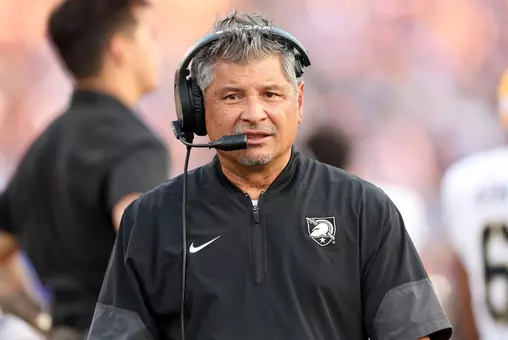
Jeff Monken and his players knew what kind of emotion they were going to be facing and they were ready for it.
Most of the morning rain was gone by kickoff and a sellout crowd of 38,502 packed the stadium on a sunny, but very windy afternoon.
Army got the ball first—for the first time all season—and put together an extraordinary drive, overcoming three 15-yard penalties, two of them on chop blocks, keeping the ball for just under 13 minutes and 21 plays before Darnell Woolfolk plowed into the end zone from the 1-yard line for a 7-0 lead.
Woolfolk's run was the capper, but the most critical play had come a moment earlier. The third 15-yard penalty of the drive had moved the ball from the Air Force seven to the 22. The Black Knights had just picked up a first down on a Woolfolk 4th-and-2 run—more on fourth down plays later—before the penalty pushed the ball back.
Earlier in the drive, facing a 1st-and-25, quarterback Kelvin Hopkins Jr. had found Jordan Asberry for 14 yards—a critical pickup at that juncture. Now, under a heavy rush, he laid a pass out for Asberry near the sideline.
It looked as if the ball was beyond Asberry's reach and, even if he somehow caught it, he would be out-of-bounds. That's what the officials thought too. As Asberry stretched for the ball at the two, they ruled him out-of-bounds. But replay showed that he had miraculously gotten his knees and an elbow down just inside the boundary.
A moment later, Woolfolk scored. A word here about Asberry: he doesn't touch the ball that often but when he does good things happen. He is one of those players who rarely appears in a headline, but helps make the team successful.
The teams then exchanged punts—in-between TV timeouts brought about by Army's initial drive taking so long—and Air Force, aided by a ticky-tack personal foul call on James Nachtigal, moved into Army territory. The penalty earned Nachtigal a stern talking to from Monken, because he HAD shoved an Air Force player at the end of a play and that kind of post-whistle emotion is never a good idea.
The defense stopped Air Force's fine fullback Cole Fagan on a 3rd-and-4 and, with the ball on the Army 45, Calhoun opted to play field position and decided to punt.
Some football sage had commented on the radio prior to the game that fourth down might be the deciding factor in this game. Army was 26-of-29 coming in—best in the country. Air Force was 19-of-29—second best in the country. At that moment in the second quarter, Calhoun turned timid.
It cost him.
Army took over at the 11 and rushed the ball 11 straight times—going 89 yard to score. Hopkins, who took a licking and somehow kept on ticking all day, had to come out for one play on a 3rd-and-4 at the Army 39. Cam Thomas came in and almost got the first down, coming up a half a yard short.
FOURTH DOWN. Army's wheelhouse. Monken never flinched. Hopkins came back in the game and handed to Woolfolk who got a huge block from center Bryce Holland and went 52 yards to the Air Force 6.
At that moment, Army was 2-for-2 on fourth down; Air Force 0-for-0. That was critical. Hopkins spun in on the next play and it was 14-0.
That was the halftime score after a Mike Reynolds' interception inside the 10 killed Air Force's last drive of the half. Army had shut Air Force out for six straight quarters.
But Air Force wasn't going to simply roll over. It's no fluke that the Falcons have been to 23 bowls under three coaches dating to 1982, including 9-of-11 years under Calhoun.
Hammond came in and the game changed completely in the third quarter. The Army offense became predictable and went three-and-out twice. On the second punt of the half, the usually reliable Nick Schrage hung on to the ball too long trying a rugby kick and it was partially blocked and only went four yards.
Air Force took over at the Army 34 and needed nine plays to finally find the end zone, Hammond going in from the one a couple plays after he had picked up a 4th-and-1 from the 10. The extra point snap was high and wide and Jake Koehnke clanked it off the goal post, so it was 14-6.
Army FINALLY began to move the ball, helped by offensive coordinator Brent Davis calling a quick out pass to Glen Coates on the first play of the drive that picked up nine yards. Woolfolk then picked up Army's initial first down of the half—on the last play of the third quarter.
The Black Knights kept grinding, aided by a facemask penalty on Air Force's Mosese Fifita—one of the few calls all day the officials clearly got right—but stalled at the 13 when Coates couldn't get to the corner on what looked like a perfect call—a counter pitch play.
Monken thought about going for it on 4th-and-4 but decided (correctly) a two-score margin was a good idea and sent John Abercrombie in to kick a 30-yard field goal. Abercrombie is another unsung hero: he's 6-for-6 since taking over the placekicking job, including the critical 37-yarder in overtime against Miami.
The 17-6 lead didn't last long, thanks in part to a truly awful call by the officials. With Air Force facing 3rd-and-10 on its own 47, Hammond tried to find Sanders. Reynolds put his hand on Sanders back as the ball flew WAY over Sanders head. No doubt, there was contact. No doubt, Sanders would have had to be about 9-feet tall to have any chance to catch the ball.
The flag flew anyway. The officials had a bad day—missing calls on both sides—but that one was potentially critical. Instead of facing 4th-and-10, Air Force had a first down.
Three plays later, Joseph Saucier took a perfect option pitch from Hammond and scored from 6-yards out. Then the Falcons ran the same play the other way on the two-point conversion and Saucier walked in to make it 17-14 with 5:27—forever—left on the clock.
The Black Knights managed one first down on a rare fullback pitch to Woolfolk, who finished with 117 yards on 21 carries, but then stalled. On 3rd-and-8 from the 32, Hopkins tried to go deep to Kjetil Cline, who was double-covered. As Cline started to go up for the ball, he was knocked down by Zane Lewis.
The argument could be made that the ball wasn't catchable, but it was at least as catchable as the pass to Sanders that had drawn the flag.
There was no call.
And so, it came down to the defense—again. And it was the two linebackers, Christiansen and Nachtigal who made the two critical plays.
The game though, wasn't quite over after the fourth down stop. Calhoun used his two remaining timeouts on the first two plays—a Woolfolk dive for two yards and a Hopkins option that picked up four. Hopkins then ran right and picked up three to the 49. Out of timeouts, Air Force had to watch the clock melt to 17 seconds before Monken called time to avoid a delay-of-game penalty.
Now, it was up to Schrage: get the punt off and make Air Force go at least 50 yards with no time outs left to set up a possible field goal. That wasn't Monken's thinking though: he didn't want to chance a bad snap; a dropped snap or a block. And, he believed in his offensive line.
"If we can't pick up one foot," he said. "We don't deserve to win."
They picked up that foot—Hopkins running directly behind Holland.
Finally, it was over. Army had won fourth down—3-of-3—and it had been the tougher team on the plays that mattered most. That is the mentality now.
The CIC will stay at West Point next year, regardless of the outcome of the Navy game. The Black Knights are 7-2 and have now won five straight, not to mention 11 in a row at Michie. They have two home games left against FCS opponents—one of them 8-0 Colgate—before the Navy game.
There was an unfortunate postgame skirmish, no doubt born at least in part by Air Force players frustration. Then, after the playing of the Air Force alma mater, the Falcons walked almost slow motion to stand behind the Black Knights for the playing of 'Alma Mater.'
The band waited. Finally, when the Falcons were in place Monken yelled for all to hear, "It's (the CIC) staying here!" Then he added, "let's roll Maestro."
He was talking to the band but he could have been talking about his team. The Black Knights are rolling and Monken is clearly the Maestro.
Maybe Saturday wasn't a miracle. It was, however, without doubt, yet another Michie Memory.
It may be time to give a name to the heart-stopping football games that have defined Army's 11-game winning streak at home that now dates back two years.
How about, "Michie Miracles?"
The description might not be perfect, but the alliteration certainly works.
It isn't as if every game in the current string has come down to the final play, but it certainly feels that way.
It certainly felt that way Saturday after Air Force had closed from a 14-0 halftime deficit to 17-14 and got the ball back with plenty of time left in the game.
Sure enough, the Falcons were rapidly closing in on field goal range—at least. Quarterback Donald Hammond III, who came in at halftime to spark the Falcons offense, quickly found Geraud Sanders down the seam for 19 yards to the Army 47.
Air Force had been able to gash the Army defense through the air for most of the second half. For some reason, coach Troy Calhoun went conservative at that moment: calling four straight running plays. The first two picked up nine yards and put the ball on the 38. Apparently Calhoun had decided to get into field goal range and play for overtime.
That decision led to the latest Michie Miracle.
On 3rd-and-1, Hammond handed to Kadin Remsburg, who never had a chance to get close to the marker as Cole Christiansen came flying in. He brought Remsburg down for a two-yard loss at the 40.
With the clock ticking toward a minute, Calhoun opted not to use one of his two remaining time outs to make sure he had exactly the play he wanted. Instead, Hammond, who had run very few option plays all day, ran right on an option and, like Remsburg, had no chance.
The team of Christiansen and James Nachtigal was all over him, driving him to the ground for no gain.
The miracle wasn't yet complete with 1:10 to go, but it was close.
Of course, this sort of thing was nothing new for the defense inside this stadium.
A year ago, against Eastern Michigan, James Gibson made a diving tackle inside the 1-yard line on a two-point conversion attempt that would have won the game for the Eagles.
A month later, when the offense failed to produce any second half points against Duke, the defense kept the Blue Devils at bay in a 21-16 victory.
Of course, in between there was a real miracle against Temple: Kelvin Hopkins Jr. coming off the bench with Army needing a touchdown to tie and somehow taking the Black Knights 79 yards in 1:30, finding Jermaine Adams for the tying score with one second left.
Army won in overtime—of course.
This season has been more of the same. In September, Hawaii then 4-0, drove downfield in the final minute for what seemed like an inevitable tying touchdown, before the defense stopped the Rainbow Warriors on the Army 11-yard line when Christiansen (sound familiar?) dropped in coverage and broke up a pass in the end zone.
Against Miami (Ohio) when all looked lost, Javhari Bourdeau and Elijah Riley combined to stop yet another two-point conversion—this one in overtime—for another one-point victory.
All of which brought Air Force to town. The Falcons have been less than overwhelming this season, arriving with a 3-5 record. But they had played better in the last month, leading Boise State in the second half a week ago before losing by 10.
What's more, this was a role reversal game. Prior to last year's game in Colorado Springs, Air Force had gone 25-3 against Army, since the Black Knights victory in 1988. Beyond that, Army had last beaten Air Force two years in a row in 1977, the second victory in a three-game winning streak.
Year after year, Army players would vow that this time it would be different, that they were ready to beat the Falcons. And, almost without fail, for all the emotion and energy they poured into the game, Air Force would come out on top.
But this is a different time and a different era in Army football. A year ago, with Ahmad Bradshaw running amok against the Air Force defense—265 yard on 23 carries—and the defense pitching a shutout, the Black Knights walked out of Falcon Stadium with a stunning 21-0 victory and went on to win the Commander in Chief's Trophy for the first time since 1996.
That meant it was Air Force's turn to vow revenge, to make sure people knew that this year would be different, that—having already beaten Navy—they were going to fly home with the CIC back in its possession.
Jeff Monken and his players knew what kind of emotion they were going to be facing and they were ready for it.
Most of the morning rain was gone by kickoff and a sellout crowd of 38,502 packed the stadium on a sunny, but very windy afternoon.
Army got the ball first—for the first time all season—and put together an extraordinary drive, overcoming three 15-yard penalties, two of them on chop blocks, keeping the ball for just under 13 minutes and 21 plays before Darnell Woolfolk plowed into the end zone from the 1-yard line for a 7-0 lead.
Woolfolk's run was the capper, but the most critical play had come a moment earlier. The third 15-yard penalty of the drive had moved the ball from the Air Force seven to the 22. The Black Knights had just picked up a first down on a Woolfolk 4th-and-2 run—more on fourth down plays later—before the penalty pushed the ball back.
Earlier in the drive, facing a 1st-and-25, quarterback Kelvin Hopkins Jr. had found Jordan Asberry for 14 yards—a critical pickup at that juncture. Now, under a heavy rush, he laid a pass out for Asberry near the sideline.
It looked as if the ball was beyond Asberry's reach and, even if he somehow caught it, he would be out-of-bounds. That's what the officials thought too. As Asberry stretched for the ball at the two, they ruled him out-of-bounds. But replay showed that he had miraculously gotten his knees and an elbow down just inside the boundary.
A moment later, Woolfolk scored. A word here about Asberry: he doesn't touch the ball that often but when he does good things happen. He is one of those players who rarely appears in a headline, but helps make the team successful.
The teams then exchanged punts—in-between TV timeouts brought about by Army's initial drive taking so long—and Air Force, aided by a ticky-tack personal foul call on James Nachtigal, moved into Army territory. The penalty earned Nachtigal a stern talking to from Monken, because he HAD shoved an Air Force player at the end of a play and that kind of post-whistle emotion is never a good idea.
The defense stopped Air Force's fine fullback Cole Fagan on a 3rd-and-4 and, with the ball on the Army 45, Calhoun opted to play field position and decided to punt.
Some football sage had commented on the radio prior to the game that fourth down might be the deciding factor in this game. Army was 26-of-29 coming in—best in the country. Air Force was 19-of-29—second best in the country. At that moment in the second quarter, Calhoun turned timid.
It cost him.
Army took over at the 11 and rushed the ball 11 straight times—going 89 yard to score. Hopkins, who took a licking and somehow kept on ticking all day, had to come out for one play on a 3rd-and-4 at the Army 39. Cam Thomas came in and almost got the first down, coming up a half a yard short.
FOURTH DOWN. Army's wheelhouse. Monken never flinched. Hopkins came back in the game and handed to Woolfolk who got a huge block from center Bryce Holland and went 52 yards to the Air Force 6.
At that moment, Army was 2-for-2 on fourth down; Air Force 0-for-0. That was critical. Hopkins spun in on the next play and it was 14-0.
That was the halftime score after a Mike Reynolds' interception inside the 10 killed Air Force's last drive of the half. Army had shut Air Force out for six straight quarters.
But Air Force wasn't going to simply roll over. It's no fluke that the Falcons have been to 23 bowls under three coaches dating to 1982, including 9-of-11 years under Calhoun.
Hammond came in and the game changed completely in the third quarter. The Army offense became predictable and went three-and-out twice. On the second punt of the half, the usually reliable Nick Schrage hung on to the ball too long trying a rugby kick and it was partially blocked and only went four yards.
Air Force took over at the Army 34 and needed nine plays to finally find the end zone, Hammond going in from the one a couple plays after he had picked up a 4th-and-1 from the 10. The extra point snap was high and wide and Jake Koehnke clanked it off the goal post, so it was 14-6.
Army FINALLY began to move the ball, helped by offensive coordinator Brent Davis calling a quick out pass to Glen Coates on the first play of the drive that picked up nine yards. Woolfolk then picked up Army's initial first down of the half—on the last play of the third quarter.
The Black Knights kept grinding, aided by a facemask penalty on Air Force's Mosese Fifita—one of the few calls all day the officials clearly got right—but stalled at the 13 when Coates couldn't get to the corner on what looked like a perfect call—a counter pitch play.
Monken thought about going for it on 4th-and-4 but decided (correctly) a two-score margin was a good idea and sent John Abercrombie in to kick a 30-yard field goal. Abercrombie is another unsung hero: he's 6-for-6 since taking over the placekicking job, including the critical 37-yarder in overtime against Miami.
The 17-6 lead didn't last long, thanks in part to a truly awful call by the officials. With Air Force facing 3rd-and-10 on its own 47, Hammond tried to find Sanders. Reynolds put his hand on Sanders back as the ball flew WAY over Sanders head. No doubt, there was contact. No doubt, Sanders would have had to be about 9-feet tall to have any chance to catch the ball.
The flag flew anyway. The officials had a bad day—missing calls on both sides—but that one was potentially critical. Instead of facing 4th-and-10, Air Force had a first down.
Three plays later, Joseph Saucier took a perfect option pitch from Hammond and scored from 6-yards out. Then the Falcons ran the same play the other way on the two-point conversion and Saucier walked in to make it 17-14 with 5:27—forever—left on the clock.
The Black Knights managed one first down on a rare fullback pitch to Woolfolk, who finished with 117 yards on 21 carries, but then stalled. On 3rd-and-8 from the 32, Hopkins tried to go deep to Kjetil Cline, who was double-covered. As Cline started to go up for the ball, he was knocked down by Zane Lewis.
The argument could be made that the ball wasn't catchable, but it was at least as catchable as the pass to Sanders that had drawn the flag.
There was no call.
And so, it came down to the defense—again. And it was the two linebackers, Christiansen and Nachtigal who made the two critical plays.
The game though, wasn't quite over after the fourth down stop. Calhoun used his two remaining timeouts on the first two plays—a Woolfolk dive for two yards and a Hopkins option that picked up four. Hopkins then ran right and picked up three to the 49. Out of timeouts, Air Force had to watch the clock melt to 17 seconds before Monken called time to avoid a delay-of-game penalty.
Now, it was up to Schrage: get the punt off and make Air Force go at least 50 yards with no time outs left to set up a possible field goal. That wasn't Monken's thinking though: he didn't want to chance a bad snap; a dropped snap or a block. And, he believed in his offensive line.
"If we can't pick up one foot," he said. "We don't deserve to win."
They picked up that foot—Hopkins running directly behind Holland.
Finally, it was over. Army had won fourth down—3-of-3—and it had been the tougher team on the plays that mattered most. That is the mentality now.
The CIC will stay at West Point next year, regardless of the outcome of the Navy game. The Black Knights are 7-2 and have now won five straight, not to mention 11 in a row at Michie. They have two home games left against FCS opponents—one of them 8-0 Colgate—before the Navy game.
There was an unfortunate postgame skirmish, no doubt born at least in part by Air Force players frustration. Then, after the playing of the Air Force alma mater, the Falcons walked almost slow motion to stand behind the Black Knights for the playing of 'Alma Mater.'
The band waited. Finally, when the Falcons were in place Monken yelled for all to hear, "It's (the CIC) staying here!" Then he added, "let's roll Maestro."
He was talking to the band but he could have been talking about his team. The Black Knights are rolling and Monken is clearly the Maestro.
Maybe Saturday wasn't a miracle. It was, however, without doubt, yet another Michie Memory.
Players Mentioned

K
/ Football
WR
/ Football
RB
/ Football
DB
/ Football
QB
/ Football
LB
/ Football
WR
/ Football
WR
/ Football
DB
/ Football
OL
/ Football
QB
/ Football
LB
/ Football
DB
/ Football
DB
/ Football
K
/ Football
QB
/ Football
RB
/ FootballArmy vs. Lehigh Men's Lacrosse Game Highlights
Saturday, April 04
Army vs. Lafayette Women's Lacrosse Game Highlights
Saturday, April 04
Army Navy Baseball Stops for the Retiring of the Colors.
Friday, April 03
Army WP Rugby hosts Arkansas St. (11-APR-26)
Thursday, April 02