Army West Point Athletics
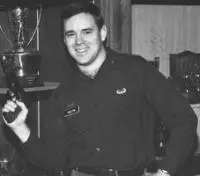
Sprint Football Recruit Shoots Way Into Hall of Fame
August 19, 2008 | General
Editor's Note: This is the third in a series of stories profiling the Kenna Hall of Army Sports inductees, Class of 2008. Each week, goARMYsports.com will take a look at these outstanding athletes and their accomplishments, leading into the induction on Sept. 19.
Richard Shelton wasn’t exactly a candidate for the hall of fame in pistol when he first entered the United States Military Academy.
Shelton was recruited to play 150-pound football (now sprint football) and didn’t know much about pistol at all. He was offered the opportunity to try out for pistol and looking for an activity, he accepted.
Turns out he was very good at it and shared his shooting talent and teaching ability with him through a long military career.
An eight-time All-American, Shelton is among the 10 people that will be inducted into the Army Sports Hall of Fame. The Class of 2008 includes nine athletes and one coach. Former men’s basketball coach Bob Knight, as well as Mike Silliman (baseball and men’s basketball), Curt Alitz (cross country, track and field and men’s swimming), George Clark (hockey), Ted Kanamine (men’s swimming), Arnold Tucker (football and basketball), Jose Olivero (lacrosse and men’s soccer), Alexis Albano (women’s soccer and track and field) and John Boretti (soccer, hockey and baseball) comprise the fifth class to be honored.
The 10 honorees will officially be inducted into the Army Sports Hall of Fame on Friday, Sept. 19. A special afternoon plaque unveiling ceremony will be held in the Kenna Hall of Army Sports inside Kimsey Center, with the formal black-tie banquet set for Eisenhower Hall later that evening. The group will also be recognized during Army’s football game against Akron the next day at Michie Stadium with a special photograph and autograph session planned in Black Knights Alley prior to the contest.
The Army Sports Hall of Fame is a subset of the Kenna Hall of Army Sports, a comprehensive museum displaying Army’s rich and proud intercollegiate athletic program. It is located on the third floor of the Kimsey Athletic Center, Army’s massive football training facility.
In addition to the 10 Hall of Fame members to be honored in September, Director of Athletics Kevin Anderson will also present the Office of Department of Intercollegiate Athletics (ODIA) Distinguished Service Award to Gus Fishburne. Fishburne, a vital resource in the Kenna Hall of Army Sports, has been a generous supporter of the United States Military Academy. His daughter, Holly, was a women’s soccer player while his son-in-law, Mark West, competed in sprint football. Both athletes graduated with the Class of 1991. His son, Gus Fishburne IV, graduated with the Class of 1994.
Shelton was an All-American shooter in all three disciplines (standard, air and free) in back-to-back seasons in 1984 and 1985. He swept all three disciplines at the National Rifle Association Championships in 1986 and earned the distinction of becoming the first shooter to capture all three competitions in the six-year history of the championship event.
Despite his lack of experience, Shelton was a four-year letterwinner and led his team to a national air pistol record of 2,175 in 1985. He was the Academy’s top shooter for four years and set an Academy and collegiate national course record (577) in standard at the World Trials.
Shelton tried out for the Olympics in 1984 in a field of 168 shooters. He finished 26th at the trials and then focused on his military career. He became a Distinguished Pistol Shooter and was selected on two occasions as a President’ 100 shooter.
During his military career, he qualified as an “expert” in every weapon and ensured his solders were qualified on every weapon used.
His career brought him back to the Academy where he taught in 1997-98 in the Department of Civil and Mechanical Engineering and started the Hunting Club on post.
Catch Us Up On What You Have Been Doing Since Graduating: “Since I graduated from West Point, I decided not to pursue pistol. I was invited to be the Officer in Charge of the Army Marksmanship Unit but full-time shooting would have affected my military a career so I declined. I was commissioned in the Corps of Engineers and had a full career, 20 years (retiring as a Lt. Col. two years ago). I served throughout Europe and the United States and taught at West Point for a couple of years.”
Shelton now works as a Design-Build Operations Manager at KBR Government and Infrastructure in Arlington, Va.
Reaction When Received Letter You Were Chosen: “I didn’t know there was a Hall of Fame. My wife called me when the letter from West Point arrived and since our son is a plebe at the Academy, we were always concerned. She opened it and said I was inducted and we didn’t really know what it was. We got on-line and did some research to learn more about it and are thrilled.”
Favorite Athletic Memory: “We had a really tight team and had a lot of fun. They used to use C12s, little twin engine Cessna that they kept at Stewart Airport that the Superintendent would use. Our team would occasionally travel and use those planes. A coach and team of four or five shooters would hop in a plane and compete for the weekend.”
Favorite West Point Memory: “The efficiency of the place and all the good friends. I was from Long Island so I wasn’t too far away but all the good friends I made stands out.”
What Does It Mean To Be Inducted: “It means a lot. It might sound kind of off but there was a mourning effect when I retired and I missed it, missed it tremendously. There is a mourning period you go through when you are no longer a part of something much bigger than you. It feels great to earn recognition from an organization I really believe in and something that has been such a big part of my life.”
Who Had The Biggest Influence On Your Athletic Career: “My coach Jack McJunkin. He was an active duty sergeant who had a pretty good career with the Army Marksmanship Unit out of Fort Benning. He believed in me and was a very positive influence and we later became friends. And Eric Buljung, a master sergeant who won a silver medal at the 1988 Olympic Games. I had a tendency to try and be the best at the match, that was the goal. He taught me that my goals were too low and I had the capability to do much better.”
What’s The Biggest Difference At West Point Since You Were A Cadet: “When I went back to teach, there seemed to be a lot more mutual respect between teachers and students. Maybe it was a different perspective but it didn’t seem that the instructors were as harsh on the students as when we were cadets. There was a mutual respect that seemed to be much more conducive to encouraging people to do their best.”
Tickets for the event are available to the public and can be purchased by calling Army's External Operations Office at 845-938-2322. Proceeds will be directed to a fund that supports the daily care, maintenance and growth of the Kenna Hall of Army Sports and Army Sports Hall of Fame.