Army West Point Athletics
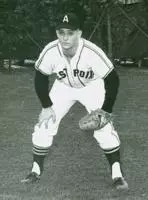
Three-Sport Standout Earns Hall of Fame Nod
August 14, 2008 | General
Editor's Note: This is the second in a series of stories profiling the Kenna Hall of Army Sports inductees, Class of 2008. Each week, goARMYsports.com will take a look at these outstanding athletes and their accomplishments, leading into the induction on Sept. 19.
A three-sport standout, John Boretti starred in soccer, hockey and baseball and capped his nine-varsity letter career by winning the Army Athletic Association Trophy as the Academy’s top male athlete.
Yet at one point, Boretti was ready to give up baseball. Coming off hockey season in the winter of his sophomore year at the United States Military Academy, his shoulder was bothering him and he was thinking about giving up baseball and playing intramural lacrosse.
A conversation with his father changed that and Boretti returned to the baseball field. He accompanied the team on a trip to Florida and was inserted as the starter in center field, despite his lack of experience. Utilizing an infielders’ glove, Boretti said he went on to start every game and every inning the rest of his career.
His accomplishments in baseball, as well as soccer and hockey, have earned Boretti a spot in the Army Sports Hall of Fame.
Boretti is one of 10 people who will be inducted into the Army Sports Hall of Fame. The Class of 2008 includes nine athletes and one coach. Former men’s basketball coach Bob Knight, as well as Mike Silliman (baseball and men’s basketball), Curt Alitz (cross country, track and field and men’s swimming), George Clark (hockey), Ted Kanamine (men’s swimming), Arnold Tucker (football and basketball), Jose Olivero (lacrosse and men’s soccer), Alexis Albano (women’s soccer and track and field) and Richard Shelton (pistol) comprise the fifth class to be honored.
The 10 honorees will officially be inducted into the Army Sports Hall of Fame on Friday, Sept. 19. A special afternoon plaque unveiling ceremony will be held in the Kenna Hall of Army Sports inside Kimsey Center, with the formal black-tie banquet set for Eisenhower Hall later that evening. The group will also be recognized during Army’s football game against Akron the next day at Michie Stadium with a special photograph and autograph session planned in Black Knights Alley prior to the contest.
The Army Sports Hall of Fame is a subset of the Kenna Hall of Army Sports, a comprehensive museum displaying Army’s rich and proud intercollegiate athletic program. It is located on the third floor of the Kimsey Athletic Center, Army’s massive football training facility.
In addition to the 10 Hall of Fame members to be honored in September, Director of Athletics Kevin Anderson will also present the Office of Department of Intercollegiate Athletics (ODIA) Distinguished Service Award to Gus Fishburne. Fishburne, a vital resource in the Kenna Hall of Army Sports, has been a generous supporter of the United States Military Academy. His daughter, Holly, was a women’s soccer player while his son-in-law, Mark West, competed in sprint football. Both athletes graduated with the Class of 1991. His son, Gus Fishburne IV, graduated with the Class of 1994.
During three seasons of soccer with coach Joe Palone, Boretti helped the squad to the semifinals of the NCAA Tournament each season. The team went 12-1-1 in 1965 and established the school record for winning percentage.
Boretti was an infielder during his scholastic baseball career but quickly made the adjustment to the outfield and earned first team All-Eastern Intercollegiate Baseball League twice. He is one of just six Army players to earn first team All-EIBL honors in successive seasons. A team captain as a senior, Boretti posted a career-best .304 batting average as a junior. He also competed against the New York Yankees and New York Mets in exhibition games and was a part of two EIBL championship teams.
Boretti spent winters on the ice at Smith Rink where he served as a defenseman with seven goals and 20 assists in 75 games.
Catch Us Up On What You Have Been Doing Since Graduating: “I served four years, in Germany, Vietnam and Key West, Fla., and was with missile outfits everywhere except Vietnam. After I left the military, I spent 29 years working for Procter & Gamble and am now retired and living in North Carolina. I retired early and was lucky. Now I am living my second childhood and playing golf every day.”
Reaction When Received Letter You Were Chosen: “I was pretty overwhelmed. I can honestly say it was a dream of mine but I also knew there were a lot of people who were probably more qualified than I. It was not something I was expecting. Maybe years later ... but I was overwhelmed to find out I was inducted. It brought tears to my eyes.”
Favorite Athletic Memory: “I have a couple. One of the greatest I have is coming back from losing to Michigan State in the NCAA (soccer) semifinals on a Friday. We had lost to Michigan State on a Thursday and it was a great event, playing in the NCAA Final Four. We headed home on Friday and Saturday night when the puck was dropped against Princeton, I was on the ice. It still gives me chills to think that (coach) Jack Riley, even though I only skated on weekends because of soccer practice, put me on the ice. When the puck dropped in the first game of my yearling year I was on the ice, two days after losing to Michigan State; that was a memorable moment in hockey. In baseball, I will never forget hitting the ball very, very hard in all of my at bats at Navy. We beat Navy my junior year but I will never forget getting back on the bus and I was being voted team captain. And, playing in three Final Four’s with Joe Casey, who I consider to be the best soccer player in Army history, as my captain.”
Favorite West Point Memory: “I was recruited to play hockey and my objective was to graduate and play sports so my life was all about sports. The greatest West Point memory other than sports is Col. “Red” Reeder. When Col. Reeder retired my senior year, I was the only cadet at his retirement ceremony in the Officers’ Club. I got to sit at the head table with Col. Reeder while the superintendent, commandant and others were in the audience.”
What Does It Mean To Be Inducted: “In my mind, as much as anything, it validates the quality of the teams I played on in that era. Three NCAA Final Fours, two Eastern Intercollegiate baseball championships and three pretty successful hockey teams even though we didn’t make it to the NCAA Tournament. To me, it’s a validation of the teams I played on and my teammates.”
Who Had The Biggest Influence On Your Athletic Career: “My family, my dad and three brothers and sister. My dad was so supportive. I listened to others who had demanding fathers. My dad loved sports and was so supportive from the time I started playing. I had three older brothers and they bought me gloves, skates, sticks and introduced me to the sports. My little sister was my teammate in the neighborhood. I had three great coaches, all hall of famers and not just at West Point. Eric Tipton in baseball, Jack Riley in hockey and of course Joe Palone in soccer. I had great teammates, too. When it was all said and done, my dad, brothers and sister were so influential and supportive.”
What’s The Biggest Difference At West Point Since You Were A Cadet: “The cadets seem to have a lot more freedom and the curriculum changed in terms of being able to select majors and things like that. It’s a different place and I will say it’s probably a better place. I’d like to think the people who make the changes are graduates themselves and the changes that have been made are positive.”
Tickets for the event are available to the public and can be purchased by calling Army's External Operations Office at 845-938-2322. Proceeds will be directed to a fund that supports the daily care, maintenance and growth of the Kenna Hall of Army Sports and Army Sports Hall of Fame.