Army West Point Athletics
2004 Army Sports Hall of Fame Members
June 30, 2006 | General
2004 Army Sports Hall of Fame Members
Army Sports Hall of Fame
| EARL HENRY "RED" BLAIK Class of 1920 Head Coach (1941-59) Football The winningest coach in Army football history, Earl "Red" Blaik is credited with elevating Army's football program from the "pit to the pedestal" during the 1940s. In 18 years at the Black Knights' helm, Blaik compiled a 121-33-10 record (.768) and guided Army to three consecutive national championships (1944-46). Blaik coached 28 First Team All-Americans and three Heisman Trophy winners during his incredible West Point tenure. A two-time national coach of the year selection, Blaik led Army to six undefeated campaigns and steered the Black Knights to a school-record 32-game unbeaten string (1944-47), a stretch that included a 25-game winning streak. He was an All-America end at West Point, before graduating from the Academy in 1920. Blaik served as an assistant coach at his alma mater for seven years before shouldering a similar seven-year stint as head coach at Dartmouth College. Blaik was presented with the National Football Foundation Gold Medal Award in 1966 and the Presidential Medal of Freedom in 1986 following his induction into the National Football Foundation College Hall of Fame in 1964. | |
| FELIX ANTHONY "DOC" BLANCHARD JR. Class of 1947 Football/Track and Field A three-time First Team All-American (1944-46), Felix "Doc" Blanchard, "Mr. Inside," teamed with Glenn Davis, "Mr. Outside," to form one of the most heralded backfields in college football history. Blanchard became the first junior to win the Heisman Trophy (1945) and the first football player to win the Sullivan Award (1945). Named "Outstanding Player of the Year" by both the Maxwell Club and Walter Camp Foundation in 1945, Blanchard starred on three national championship teams (1944-46). He graduated in second place on Army's career rushing list and finished with 38 career touchdowns. Blanchard was inducted into the National Football Foundation College Hall of Fame in 1959 and was presented with the Doak Walker Legends Award this spring. | |
| GLENN WOODWARD DAVIS Class of 1947 Football/Baseball/Track and Field/Basketball A three-time First Team All-American (1944-46), Glenn Davis, "Mr. Outside," teamed with Felix "Doc" Blanchard, "Mr. Inside," to form one of the most heralded backfields in college football history. Davis captured the Heisman Trophy in 1946, one year after Blanchard copped the honor. Davis finished second in the Heisman voting that season. Selected "Outstanding Player of the Year" by the Helms Foundation in 1944 and 1945, Davis was also selected "Outstanding Player of the Year" by the Maxwell Club in 1944. He graduated as Army's all-time leading rusher with 2,957 yards and still holds the NCAA record for most yards gained per carry in a career (8.3). A vital component in three consecutive national championship teams (1944-46), Davis set six other Academy career records on the gridiron and two more in track and field. Davis finished his career with a school-record 59 touchdowns, 354 points and 5,161 all-purpose yards. In all, he earned 10 varsity letters while at West Point, including four in football, three in baseball, two in track and field and one in basketball. Davis was inducted into the National Football Foundation College Hall of Fame in 1961. | |
| PETER MILLER DAWKINS Class of 1959 Football/Hockey One of the most dynamic players in Army football history, Pete Dawkins became the third Army player to win the Heisman Trophy Award when he claimed the prestigious honor in 1958. Dawkins was selected a First Team All-American, and named Player of Year by the Maxwell Club, Sports Illustrated and Sport magazines that year as well. A two-time First Team Academic All-American (1957-58), Dawkins served as Class President and Cadet Brigade Commander in 1958 and was a member of Army's last undefeated football team. In addition to his football prowess, Dawkins graduated as Army's leading career scorer among defensemen in hockey, earning three varsity letters in that sport. He was named a Rhodes Scholar recipient in 1959. A former White House Fellow, Dawkins received the NCAA Silver Anniversary Award in 1983. He was elected to the Academic All-America Hall of Fame in 1988, inducted into the National Football Foundation College Hall of Fame in 1975 and presented the Doak Walker Legends Award in 2000. | |
| CLIFF MICHAEL NATVIG Class of 1963 Wrestling Army's only two-time national champion in wrestling, Mike Natvig was crowned national champion and All-America at 147 pounds in both 1962 and 1963. One of the most dominant wrestlers in Army history, he posted a career record of 47-7-1, which translates to a remarkable winning percentage of .864. Natvig was particularly dominant en route to his individual title in 1963, yielding a combined total of three points to five different opponents. A year earlier, he became one of only two wrestlers to defeat Lehigh great Kirk Pendleton, besting his rival in the 1962 NCAA Championship finals. A consistent force on the national scene throughout his West Point tenure, Natvig qualified for the NCAA Championships during all three years of his varsity career and posted a flashy 10-1 record in NCAA Championship competition. | |
| ROBERT REESE NEYLAND JR. Class of 1916 Baseball/Boxing/Football Army's career leader in pitching victories, Bob Neyland authored a 35-5 record during his West Point career. Listed second among the Black Knights' all-time leaders in winning percentage (.875), Neyland won 20 consecutive games during one stretch in the "Black, Gold and Gray." He also fired the first no-hitter in Army history when he blanked Colgate in 1914. An undefeated heavyweight boxing champion for three years running in the Corps of Cadets (1914-16), Neyland also lettered in football and was a member of Army's undefeated 1914 club. After graduating near the top of his class in 1916, Neyland returned to West Point in 1921 as an aide to Gen. Douglas MacArthur, then Commanding General at the Academy. He also assisted in coaching football, baseball and boxing at that time before assuming duties as head football coach at the University of Tennessee in 1925. During a legendary 21-year coaching career in Knoxville, he compiled an overall record of 173-31-12. Today, the Volunteers' football stadium is named in his honor. | |
| ELMER QUILLEN OLIPHANT Class of 1918 Football/Basketball/Baseball/Track and Field One of the most decorated intercollegiate athletes in Army history, Elmer Olipant earned 11 varsity letters in four sports and monograms in three others during his career at the Academy. A two-time First Team All-American (1916-17) in football, he garnered second team All-America honors on another occasion (1915). Named to the All-Time All-American Team by Knute Rockne, Oliphant scored an Academy-record 125 points in football during his senior season and 289 points during his Army career. A champion boxer in the Corps of Cadets, "Olie" established a world record for the 220-yard low hurdles on grass and served as team captain of the football, baseball and track and field teams while at West Point. Prior to that, he starred on the athletic fields at Purdue University, earning 12 varsity letters in four sports. Oliphant was elected to the Helms Foundation Hall of Fame in 1953 and was inducted into the National Football Foundation College Hall of Fame two years later (1955). | |
| JOSEPH MICHAEL PALONE Head Coach (1947-54, 1955-57, 1958-78) Men's Soccer/Baseball A fixture on the Army sports scene for a period spanning four decades, Joe Palone retired as Army's all-time winningest men's soccer coach in 1978. He compiled a 228-80-35 coaching record over a highly successful 29-year career. Palone guided the Black Knights to 11 NCAA berths and three Eastern titles (1950-52), while building a .715 career winning percentage that still ranks among NCAA career leaders. He directed Army to the semifinals of the NCAA Championship on four occasions and registered 26 winning seasons in all. He remains on the ballot for the National Soccer Coaches Association of America Hall of Fame. In addition to his accomplishments on the soccer field, Palone served as Army's baseball coach from 1955 to 1957. | |
| JOHN PATRICK RILEY JR. Head Coach (1951-86) Hockey Army's all-time winningest coach, Jack Riley authored a 542-343-20 record during his remarkable 36-year career at the Black Knights' hockey helm. He retired in 1986 as the second-winningest college hockey head coach in NCAA history and currently ranks ninth on the list.
Riley was named NCAA "Coach of the Year" in 1957 and 1960, guided Army to 29 winning seasons and led the Black Knights to a school-record 28 victories during the 1983-84 campaign. His Army teams reached postseason play nine times in all during a career that spanned four decades along the banks of the Hudson. Riley served as head coach of the United States Olympic team in 1960 and directed the squad to its first gold medal. A two-time winner of the Lester Patrick Award (1986, 2002), presented for outstanding service to U.S. hockey, Riley was elected to the United States Hockey Hall of Fame in 1979. He was also inducted into International Hockey Hall of Fame in 1998. | |
| JOHN SIEBA ROOSMA Class of 1926 Basketball/Soccer/Baseball Army's first 1,000-point scorer, John Roosma was named to the Helms Athletic Foundation All-America team in 1926. A five-time letterwinner in basketball, he closed his career with 1,126 points, an extraordinary total for that era. In fact, the figure was not eclipsed by another Army player for three decades. Roosma was a two-time All-East honoree (1925-26) and helped Army win an Academy-record 33 consecutive games during one stretch of his West Point career (1921-23). He averaged 24 points per game as a plebe and starred for the Black Knights' undefeated squad the following year. The first and only Army player to be inducted into the Basketball Hall of Fame (1961), Roosma once set a world record by sinking 99 of 100 free throws in 1934. He later bettered that mark by making 139 of 140 free throws. | |
| ROBERT CARVER SEARS Class of 1939 Gymnastics A three-time national champion, Robert Sears finished first individually at the NCAA Championships on the horizontal bar and rope climb in 1938 and the parallel bars in 1939. A five-time Eastern champion, he earned First Team All-America honors on the horizontal bar and rope climb in 1938, and the parallel bars in 1939. An integral component in Army's vast gymnastics success during the 1930s, Sears helped lead Army to runner-up honors at NCAA Championships in 1939. He went on to additional successes following his graduation from the Academy, winning national AAU titles on both the long horse and parallel bars in 1947. A member of the Army Air Corps, Sears earned the Distinguished Flying Cross and two Air Medals, along with an Air Commendation Medal, highlighting a highly decorated military career. He was taken Prisoner of War during World War II and would eventually escape his German captors. | |
| RICHARD THOMAS SHEA JR. Class of 1952 Track and Field/Cross Country One of the Black Knights' most celebrated distance runners, Dick Shea captured Heptagonal and IC4A individual cross country titles three successive years (1949-51), helping Army to three straight team "Heps" titles during that time. The top performer on Army's dominant cross country team, Shea led the Black Knights to a 19-2 record during his West Point career, a mark that included three straight "shutouts" of arch-rival Navy. He set seven Academy records in indoor and outdoor track and field and established a meet record in the two-mile run at the prestigious Penn Relays in 1951. Shea repeated as the two-mile champ at both the Penn Relays and Heptagonal Championships in 1951 and 1952. His standards in the indoor mile run (4:10) and two-mile run (9:05.8) remained on Army's record books for more than a decade. In the past 50 years, only eight Army runners have fashioned a better time in the mile, either indoors or outdoors. Shea was killed in action in Korea on July 8, 1953, and awarded the Medal of Honor posthumously. Today, Army's outdoor track and field complex bears his name. | |
| FRANCIS MORRIS TOUCHSTONE Head Coach (1929-57) Lacrosse F. Morris Touchstone retired as Army's winningest lacrosse coach in 1957 after compiling a 214-73-4 record during a brilliant 29-year career that spanned four decades. He guided Army to a share of three national championships (1944, 1945, 1951), coached 42 first team All-Americans and two future Hall of Famers during his tenure at the helm of the Black Knights. Touchstone racked up a gaudy .743 winning percentage during his Army coaching career, leading the Black Knights to 28 winning seasons. One of the key figures in collegiate lacrosse circles, he was the first individual to serve as president of the Lacrosse Coaches Association (1953-55) and the first to serve as chairman of the Hall of Fame Committee (1954-57). Today, the United States Intercollegiate Lacrosse Association Coach of the Year Award is named in his honor. Touchstone was inducted into National Lacrosse Hall of Fame in 1960. | |
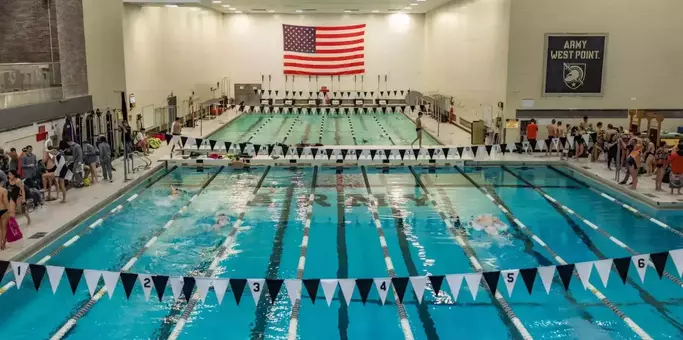
| JOHN FRANKLIN VANSANT Class of 1987 Swimming and Diving A four-time All-American, John VanSant became Army's first NCAA individual swimming champion, winning the 200-yard breaststroke in 1987. The five-time individual Eastern champion remains the Academy record-holder in the 100- and 200-yard breaststroke and 200-yard individual medley events. He was also a member of two relay teams that still hold Academy standards. VanSant set meet and Academy records in winning the 100-yard breaststrole and 200-yard individual medley at the 1986 Eastern Seaboards, helping Army to a fourth place team finish. He also swam legs on three record-setting relays and was co-winner of the Phil Moriarty Award for most points scored by an individual. He repeated as Eastern champion in the 100-yard and 200-yard breaststoke events the following year. Army's most decorated male swimmer, he qualified for the United States Olympic Trials in 1988 after competing in the World University Games in the previous year. | |
| ELEXA DIANA WILLS Class of 1990 Track and Field One of premier triple jumpers in NCAA history, Diana Wills closed her Army career as a 12-time All-American, earning certificates in the long jump and triple jump events both indoors and outdoors. Three of her Academy records remain in place, while her triple jump of 44-11 3/4 at the 1990 NCAA Outdoor Championships still ranks as the longest jump ever in NCAA Division II Championship competition. Wills graduated as the NCAA Division II record-holder in the triple jump both indoors and outdoors and captured four NCAA triple jump titles. She culminated her brilliant collegiate track and field career by sweeping the national triple jump titles indoors and outdoors as a senior. She won four successive Heptagonal outdoor crowns in both the triple jump and long jump and became the first female to win four straight long jump titles at the outdoor "Heps" Championships. She was named "Outstanding Women's Performer" of the Heptagonal Championships on two occasions (1988 indoors, 1989 outdoors) and captured two triple jump championships at the prestigious Penn Relays (1989, 1990). After winning all 32 events in which she competed against Navy during her Army career, and helping the Black Knights to a perfect 8-0 mark versus the Mids during that time, Wills represented the United States at the 1995 World Championships and the 1996 Olympic Games. She placed third in the finals of the 1996 U.S. Olympic Trials, while her personal-best leap of 46-2 at the 1995 U.S. Olympic Festival ranked her sixth among U.S. women all-time. | |
| ANN MARIE WYCOFF Class 1989 Swimming and Diving Army's most honored athlete at the national level, Ann Marie Wycoff graduated as the winningest female swimmer in NCAA Division II history. Overall, she earned nine individual national titles during her time in the "Black,Gold and Gray." Wycoff became the first Academy woman to claim an NCAA individual championship, winning the 400-yard individual medley in 1987, but that served only as a precursor to what she would achieve in subsequent years. She was named "Outstanding Female Swimmer" of the NCAA Division II Championships in both 1988 and 1989, winning four individual national titles both years. In all, Wycoff captured All-America recognition on 19 different occasions during her brilliant West Point career and set an NCAA Division II Championships record in the 400 individual medley in 1989. Thanks to her magnificent performance, Army placed fourth in the team standings at the NCAAs that year, despite having just eight swimmers compete at the meet. Wycoff remains the holder of four individual Academy records and was on a relay team that maintains yet another school standard. |