Army West Point Athletics
Feinstein's Findings: Go For Two
December 24, 2017 | Football
New York Times bestselling author, John Feinstein, is back for another season with the Black Knights and will report in after each football game during the 2017 season. Feinstein newest book titled, "The First Major,--The Inside Story of the 2016 Ryder Cup," has recently been released. Feinstein's weekly report will be posted to GoArmyWestPoint.com following each battle on the gridiron.
During the frenetic final moments of Saturday's Lockheed Martin Armed Forces Bowl, I was texting with Joe Beckerle—my pre-game and halftime radio partner—as Army, trailing San Diego State 35-28, marched down the field as the clock melted away.
When Darnell Woolfolk bolted into the end zone with 18 seconds left to make the score 35-34, I instantly texted Joe three words: "GO FOR TWO!"
It was as if I somehow thought Joe was going to make the decision. Fortunately, Jeff Monken was in charge.
Most football coaches would have kicked the extra point and guaranteed overtime. Monken knew better. He knew he didn't want to give the remarkable San Diego State running back Rashaad Penny another chance to come anywhere near the football. Penny, who will play on Sundays in the NFL for a long time as long as he's healthy, had already rushed for 221 yards and four touchdowns on just 14 carries.
Like everyone else watching the game, Monken knew this was the best player Army had faced all season. The only way to take him out of the game was to end it—one way or the other—with one last shot at the end zone.
So, thanks to back-to-back timeout calls by San Diego State, he along with offensive coordinator Brent Davis, came up with the perfect play. With the Aztecs undoubtedly expecting some kind of Ahmad Bradshaw option, Army ran a straight pitch-sweep to Kell Walker, sprinting from left to right.
The offensive line contained the SDSU defenders and John Trainor provided the final seal block on the edge—making his last college football play a memorable one without ever touching the ball—that allowed Walker to easily sprint to the corner of the end zone.
It was the last critical play of a season filled with critical plays. In a sense, that decision, that play call, that perfect execution by 11 players, defined this extraordinary season.
With the 42-35 victory over a VERY GOOD San Diego State team Saturday, the Black Knights finished 10-3, becoming the second team in the long, storied history of the Academy to win 10 games.
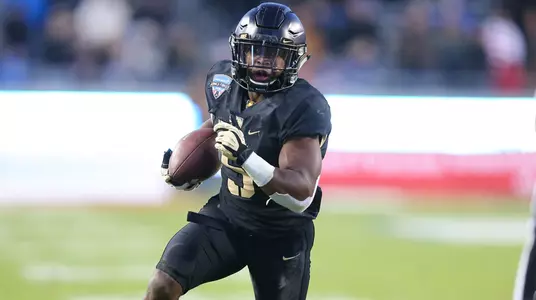
Appropriately, the other Army team to win 10 games was the 1996 team, which was also the last group from West Point to win the Commander-in-Chief's Trophy before this season. That team was quarterbacked by Ronnie McAda, who had a knack for big plays. This one was quarterbacked by Bradshaw, who had the same knack and the strength and endurance to rush for 1,746 yards, including 180 yards on 32 carries Saturday.
As a junior, McAda drove Army 99-yards in the fourth quarter against Navy to a 14-13 victory, then followed up as a senior rallying his team from 21-3 down to a 28-24 victory—and the CIC Trophy. Bradshaw engineered winning drives against the Mids in his final two seasons: a 21-17 win a year ago and the stunning 14-13 victory (note the score) in the snow 15 days ago in Philadelphia.
That '96 Army team had to face Auburn, a very good SEC team and came up just short in a 32-29 loss in the Independence Bowl. This team had to face a 10-2 San Diego State team that had beaten both Arizona State and Stanford and was going for a third straight 11-win season.
Everyone from Army was fully aware that Penny was a superb player. They just didn't know HOW superb until they saw him up close. If they had any doubts, they went away on the third play of the game, when he took the ball on 3rd-and-18 and faster than you can say, 'uh-oh, this could be a long day,' was gone—81 yards for a touchdown and a 7-0 lead less than 90 seconds into the game.
Fortunately, one of the ways Army has evolved in the past two seasons is that it can take a punch. There's never any panic. There's a belief now that the defense will make a play when it has to and the offense will be able to move the ball—against anyone.
And so it was no surprise that Bradshaw and his band of merry men, including the very under-praised offensive line and the four fullbacks—Woolfolk (21-87, two touchdowns); Andy Davidson (14-81, one touchdown); Connor Slomka (8-35) and Calen Holt (2-7)—who combined for 210 yards on 45 carries, were brilliant. Throw in Walker, who can line up anywhere and be effective (5-37 and the two-point conversion) and you can understand why defending the Black Knight this season was like sitting in a dentist's chair for hours—without novocaine.
Army's first drive lasted 10 plays and ended when Woollfolk was stopped on a 4th-and-1 at the SDSU 27.
Uh-oh.
Except the defense forced a three-and-out and, given another chance, the offense went 70-yards in eight plays to tie the score at 7-7.
Thus began the roller-coaster ride that didn't end until the game's last play. The Aztecs went up 14-7; Army answered: 12 plays, 74 yards. Army took the lead 21-14 just before halftime but Juwan Washington returned the ensuing kickoff for a touchdown to tie the score, 21-21 at the break.
It's worth noting that in six of Army's 10 victories, the Black Knights were tied at halftime four times (three of them 14-14) and behind on two other occasions. So, even though the last second touchdown was discouraging, there wasn't likely to be any hanging of heads in the halftime locker room.
Sure enough, Army took the second half kickoff and began another long march, eating up much of the third quarter clock. But a fake-field goal attempt from the SDSU 19—on the 20th play of the drive—failed and, sure enough, the Aztecs took the lead again at 28-21 on another Penny touchdown soon after that.
Then came, arguably the most important sequence of the game. Davis has had a lot of good luck this season digging into his bag of tricks with gadget plays and he decided to pull one out on Army's next drive, an option pass thrown by Kjetil Cline. This time, there was no magic, just an interception by Anthony Luke, who returned the ball to the Army 14.
Suddenly, the Aztecs were in position to go up two scores. But, after an Army penalty and an SDSU penalty put the ball on the 21, Alex Aukerman intercepted Christian Chapman's 2nd-and-goal pass to stop the drive—and change the momentum 180 degrees.
Given new life, the Black Knights promptly drove 79 yards in 10 plays to tie the game once last time, at 28, Bradshaw going the final 27 yards for his second touchdown of the game and—as it turned out—the last of his storied career.
Penny, who had already returned seven kickoffs for touchdowns while an Aztec, promptly took the ensuing kickoff to his team's 41-yard line, before being aided by a Army penalty, which shifted to the ball to the Black Knights' 44. Four plays later he scored the last touchdown of HIS storied career and it was 35-28 with 5:42 left.
Pick a cliché: Last chance. Back-to-the-wall. Now or never.
Army had the answers to them all. It wasn't easy, especially after Walker was whistled for a personal foul that moved the ball back to the San Diego State 38 with the clock under two minutes. One last time, Bradshaw came to the rescue. On 2nd-and-17, he picked up nine yards. On 3rd-and-8, he picked up 14. From there it was Walker for 12; Bradshaw for two and Woolfolk into the end zone to make it 35-34.
The rest will be part of Army history forever. As if they were running a sweep midway through an August practice, Bradshaw got the ball to Walker, the blocking was perfect, and he put the capper on an extraordinary season.
On San Diego State's desperation lateral-filled final play, the ball found its way into Elijah Riley's hands and the sophomore returned the fumble for a touchdown to make the final a deceiving 42-35.
This was an historic season. Two falls ago, when Army was 2-10, the rationale was that eight of the ten losses had been by a total of 40 points—many of those defeats coming down to the last minute, sometimes the final play.
Monken harped then on doing the little things that were part of being a winning team: not turning the ball over; not fumbling; not taking critical penalties. Those little things, he said, were always going to be the difference at Army. He knew his players would always compete; he also knew the margin for error would always be razor-thin.
This year proved that definitively. Army did ALL the little things right all season long. Six of its 10 wins were by a total of 21 points—15 if you don't count the bonus-six on Saturday. And, in the most important moments of the season, it was NAVY that committed two critical penalties, which forced Bennett Moehring's last-second field goal to come from 48 yards instead of closer. He JUST missed.
Army won by inches—and by one point. All that matters though, is that it won. Just as all that mattered in 2015, was that it lost all those close games.
Bradshaw will be gone next season. So will a number of key seniors on both sides of the ball. But the foundation is now in place for continued success and the expectations in 2018 will certainly be high.
It is 250 days from here to opening day September 1 at Duke. There will be many questions to be answered starting that day. For now though, the questions for 2017 have all been answered—emphatically.
Now it is time to savor all that we have witnessed the last four months.