
Army West Point Athletics
MISSION FIRST: Leading From The Front
December 01, 2016 | General, Men's Basketball
There would seem to be only one starting point for Maxwell Lenox. Where else do you begin your story as a black man born to a mom tainted by drugs and alcohol, put up for adoption, fathered by two white gay men and somehow going on to earn a West Point diploma? He can't exactly save those pieces for the epilogue.
Lenox has no problem recounting his story, told vividly and beautifully by Sports Illustrated magazine in November 2014. He is forever prideful of and thankful for his upbringing, for his parents, Dave Lenox and Nathan Merrells, for his gifts both on and off the basketball court. Yet he's quick to note that his tale includes other starting points, other potential landmines that required extraordinary determination in his remarkable journey to the graduation stage of the United States Military Academy.
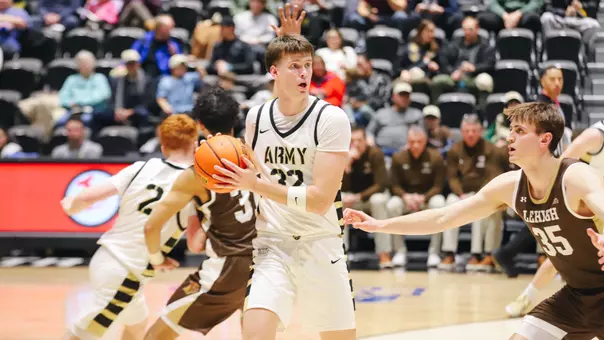
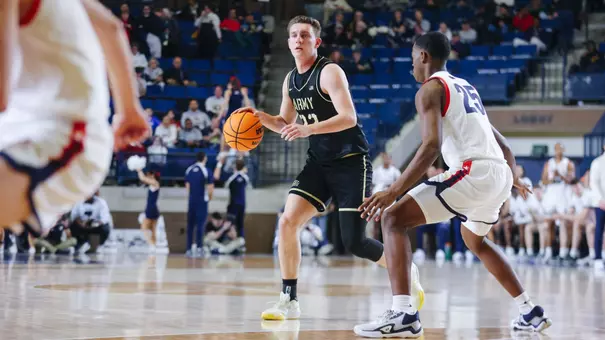
So we start here, freshman year at West Point, 2011, a high school basketball star feeling the depths of Division I basketball while trying to navigate one of the harshest academic struggles in America. He will go on to make the Patriot League All-Rookie team, become one of two Army freshmen to play in all 30 games, start seven contests and lead the team in assists (3.2) and steals (1.3). It won't be enough to keep him in the starting lineup. The demotion coincides with Lenox's grades slipping. Wait, no, let's back it up a bit and start here, along the playgrounds and AAU courts in and near Fairfax, Va., where Max Lenox is the fiercest force in the game.
"He was interesting because he was more mature, body-wise,'' Mo Williams says in describing Max's blend of size and skills as a sixth-grader. "He was a problem. He was really tough to guard. My (AAU) coach didn't worry about anyone else. All he focused on was trying to stop Max.''
And Lenox often was unstoppable. Williams knew, because long before they became best friends and eventual West Point schoolmates and teammates, he tried to guard Lenox virtually every weekend in tournaments. He still thinks of the picture of them as part of an all-tourney team that shows Lenox's man-child physique compared to kids his age.
"I started playing on a 'rec' team at six-years-old, in first grade,'' Lenox remembers. "I really fell in love with it in third grade, fourth grade. That's when I started working my butt off. I was a better tennis player, but I didn't work hard at tennis.''
In fact Lenox was immediately good in every sport he tried, except basketball. He was, his words, "awful'' at basketball when he first started. But that only drew Lenox closer to the game and made him more determined to thrive at it. His body continued to mature and Lenox sweated through his hardcourt flaws.
"Moving on, it was the competition I loved,'' he says. "I loved to fight against myself to be better. I loved all the fighting aspects necessary to win the game.''
He wasn't just good by the time he hit the AAU circuit. He was tough. The AAU scene is often a show of naturally talented kids flying through the air for rim-jarring dunks, uber-athletes stopping on a dime for perfect pull-up jumpers and gliding across passing lanes for sudden steals, all with just their feet touching the floor.
Then there was Lenox, who couldn't resist kissing any crevice on the court that was surrounded by a basketball rolling aimlessly amid a group of bodies. He dived and skidded along the floor like a boy testing his new sled at first snowfall. Body be damned, there was a possession at stake, a ball to be grasped, a game to be won.
A life to be lived.
There was something else burning inside of Lenox beside the ripe raspberries earned through his gritty play. Boys will be boys, and kids will be kids, and too often adults will be children, so there were sadly inevitable barbs and verbal blows when you are raised by two gay men, and of a different color at that. Lenox felt compelled to raise his fists on more than one occasion, but by the time he was ruling high school courts and the words fading mostly to whispers, he was raising something else: awareness.
Fairfax was a melting pot of contrasting demographics, in many ways an ideal environment for Lenox. He gravitated toward kids of all colors and ethnicities, all shapes and sizes, all clubs and cliques and sports. He stood up to bullies who focused their ignorance on others, knowing the feeling, the hurt, of gut-wrenching words. Yet he rarely revealed his pain, to Williams or anyone else, for Lenox seemed to recognize a cause greater than himself.
As kids started to catch up to Lenox on the court physically, he was setting himself apart as a leader of men. He had a long ways to go, of course, still mostly fixated on winning basketball games. He didn't see his special leadership qualities taking him to the ultimate leadership academy. Only a small percentage of kids make West Point their childhood dream. Lenox had visions of a more common boyhood fantasy, stopping at a big-time basketball school on his way to the pros. He might not have been cut out for the best of the best such as Duke or Kentucky, not as a 6'0'' guard lacking otherworldly athleticism. But pretty much everyone else wanted him on their campus. Influential basketball eyes studied Lenox and recruiting letters flooded in from around the country.
Then he suffered a torn meniscus weeks before junior year at WT Woodson High. Lenox barely got onto the court that season and college basketball programs lost his address.
He responded with a big senior season, averaging 22.8 points, 6.1 rebounds and 3.7 assists before earning league Player of the Year honors. Lenox's grades, though, were mostly "Cs" and he had missed the crucial recruiting window while recovering from his knee injury as a junior. Lenox wound up at Fork Union Military Academy in rural Virginia, where he met the school's four-decade coach, Fletcher Arritt.
Arritt became nothing short of a third father to Lenox. The coach helped guide the boy on and off the court, teaching him how to play, for sure, but also instilling in Lenox the power of perspective and purpose. Lenox led FUMA to a 26-7 season. Arritt's sound relationship with West Point allowed Lenox another chance at Division I hoops, albeit on a smaller scale while taking six-syllable courses and marching with 50-pound backpacks strapped onto his broad shoulders.
"He showed me what I wanted to be as a man,'' Lenox says. "As a leader, he was probably the best leader I have ever been under.''
West Point freshman year. Another starting point. Max was having a credible season on his way to making the Patriot League All-Rookie team. Coach Zach Spiker was clearly impressed by the kid's ability to lead teammates on the court. But Spiker had spent considerable time in other teen-aged living rooms across America, having stored a star recruiting class at the USMA Prep School while Lenox made his Army debut as a freshman. But now, with those freshmen still a season from joining the team, Spiker still saw fit to replace Lenox in the starting lineup. Meantime Lenox, an undisciplined student, started sliding toward the brink of dismissal.
He struggled all first semester but crammed when necessary and maintained at least a C-minus average in all his courses entering finals. Then Lenox fumbled the basketball in academic crunch time, failing three finals. He flunked two classes, got a "D" in another and soon learned the fate common to many West Point freshmen. He would have to repeat his freshman year, known in Academy vernacular as being "turned back."
"My whole world was crashing,'' he says. "My time management was awful because I never put school first. I put basketball first. It had opened all these doors for me, so I focused on it.''
Lenox considered transferring to another school.
His phone rang. It was Fletcher Arritt, enduring a battle known as cancer, sharing 70 years of knowledge and perspective and belief. His words might now sound like basic concepts, but they were being delivered by a mountain of a man, the kind of man Max would emerge from a foxhole to save.
Never get too high; never get too low, the sage told Max. You can do this, I know you can.
Max repeated his freshman year and discovered the proper balance between basketball and books. In a perfect world, where kids are born to healthy moms, where bigotry and homophobia and all forms of hate cease to exist, Max Lenox would have regained his starting spot as a sophomore, led Army to a couple NCAA Tournament berths and worked off his postgraduate military commitment while getting a shot at the pros. But the prep-school studs arrived and Lenox played his entire sophomore season off the bench, averaging 1.7 points and 1.4 rebounds. Another starting point. While Lenox still treasured the game, he no longer needed it.
Lenox had learned that with each dip into adversity came the light of a guiding beam. There was, first and foremost, Dave Lenox and Nathan Merrells angelically dropping in to provide a structured home after he was put up for adoption. There was the miracle of developing into a healthy child after absorbing the remnants of his birth mother's vices during pregnancy. There were kids through his high school years cheering Lenox and tucking the cruel barbs into a distant slaughterhouse. There was a brilliant woman at West Point named Dr. Angela Fifer, an instructor with a student assistance center called the Center for Enhanced Performance, sharing her wisdom that convinced Lenox to stay at the Academy when he wavered on multiple occasions. And there was Fletcher Arritt, a man 50 years his senior, similarly pulling up Lenox when he considered transferring.
All those lessons. All those models. Now Lenox was accomplishing the remarkable task of making teammates and classmates better despite playing sparingly his final three seasons.
"He probably kept a lot of people there,'' Williams says.
He doesn't just mean keeping them focused on the court. He means keeping them from leaving West Point with his mind-altering leadership skills.
All the while, his numbers and minutes remained miniscule. Lenox averaged 1.7 points and 6.0 minutes in 11 games off the bench his junior season.
With the 2014-15 season essentially a redshirt season – cut short to seven games because of an injury – he came back in 2015-16 to play in just three games and 10 total minutes, scoring six points with seven rebounds and no assists his senior season.
Yet he was voted a captain by teammates both of his final two seasons, and Army, forever a Patriot League doormat, went a combined 34-29, reaching the league tournament semifinals senior year.
You can virtually see Spiker shaking his head in awe over the telephone when asked of Lenox's influence on teammates. You don't pick leaders, Spiker suggests. Leaders are born.
Mo Williams, Lenox's buddy from Fairfax, was a captain alongside Max his junior year. With Williams having graduated and become an athletic intern (known as graduate assistants at civilian schools) for Lenox's senior season, Mo sat in on player discussions over their choice of captains. "There were seven (seniors) and they probably were all worthy of being captains,'' Williams says. "Max stood out because he had the ability to connect with others. He had the ability to connect with anybody on the team.''
Lenox has trouble mustering the words to describe the day in May 2016 when he stepped onto stage for his West Point diploma. "I didn't really have any emotions when I was walking across the stage,'' he says. "Then I saw my parents and they were crying, and I started to cry. … It was awesome. Obviously they did an amazing job; they overcame a lot and we've overcome a lot as a family. We all helped each other get through everything."
He was sitting at home in Seattle, where his parents had moved in 2014, awaiting the next step in his military career. Lenox would head back to West Point in July to assist in Cadet Basic Training, Beast Barracks, for incoming freshmen. He would go to basic training in August and begin Ranger School in March 2017. Max figures to be deployed in 2018.
"I better be ready when the time comes,'' he's saying. "I really have to take my training seriously. I have to get better every single day.''
Another starting point. Max chose Infantry after first picking Armor as his military branch. He switched branches after a "three-star" general named Robert Brown, a former Army basketball standout in his own right, provided this analogy: Do you want to be on the court, or do you want to sit on the bench?
Easy answer. Easy decision. Max was born to be in the front. Basketball is just a game.
Lenox has no problem recounting his story, told vividly and beautifully by Sports Illustrated magazine in November 2014. He is forever prideful of and thankful for his upbringing, for his parents, Dave Lenox and Nathan Merrells, for his gifts both on and off the basketball court. Yet he's quick to note that his tale includes other starting points, other potential landmines that required extraordinary determination in his remarkable journey to the graduation stage of the United States Military Academy.
So we start here, freshman year at West Point, 2011, a high school basketball star feeling the depths of Division I basketball while trying to navigate one of the harshest academic struggles in America. He will go on to make the Patriot League All-Rookie team, become one of two Army freshmen to play in all 30 games, start seven contests and lead the team in assists (3.2) and steals (1.3). It won't be enough to keep him in the starting lineup. The demotion coincides with Lenox's grades slipping. Wait, no, let's back it up a bit and start here, along the playgrounds and AAU courts in and near Fairfax, Va., where Max Lenox is the fiercest force in the game.
"He was interesting because he was more mature, body-wise,'' Mo Williams says in describing Max's blend of size and skills as a sixth-grader. "He was a problem. He was really tough to guard. My (AAU) coach didn't worry about anyone else. All he focused on was trying to stop Max.''
And Lenox often was unstoppable. Williams knew, because long before they became best friends and eventual West Point schoolmates and teammates, he tried to guard Lenox virtually every weekend in tournaments. He still thinks of the picture of them as part of an all-tourney team that shows Lenox's man-child physique compared to kids his age.
"I started playing on a 'rec' team at six-years-old, in first grade,'' Lenox remembers. "I really fell in love with it in third grade, fourth grade. That's when I started working my butt off. I was a better tennis player, but I didn't work hard at tennis.''
In fact Lenox was immediately good in every sport he tried, except basketball. He was, his words, "awful'' at basketball when he first started. But that only drew Lenox closer to the game and made him more determined to thrive at it. His body continued to mature and Lenox sweated through his hardcourt flaws.
"Moving on, it was the competition I loved,'' he says. "I loved to fight against myself to be better. I loved all the fighting aspects necessary to win the game.''
He wasn't just good by the time he hit the AAU circuit. He was tough. The AAU scene is often a show of naturally talented kids flying through the air for rim-jarring dunks, uber-athletes stopping on a dime for perfect pull-up jumpers and gliding across passing lanes for sudden steals, all with just their feet touching the floor.
Then there was Lenox, who couldn't resist kissing any crevice on the court that was surrounded by a basketball rolling aimlessly amid a group of bodies. He dived and skidded along the floor like a boy testing his new sled at first snowfall. Body be damned, there was a possession at stake, a ball to be grasped, a game to be won.
A life to be lived.
There was something else burning inside of Lenox beside the ripe raspberries earned through his gritty play. Boys will be boys, and kids will be kids, and too often adults will be children, so there were sadly inevitable barbs and verbal blows when you are raised by two gay men, and of a different color at that. Lenox felt compelled to raise his fists on more than one occasion, but by the time he was ruling high school courts and the words fading mostly to whispers, he was raising something else: awareness.
Fairfax was a melting pot of contrasting demographics, in many ways an ideal environment for Lenox. He gravitated toward kids of all colors and ethnicities, all shapes and sizes, all clubs and cliques and sports. He stood up to bullies who focused their ignorance on others, knowing the feeling, the hurt, of gut-wrenching words. Yet he rarely revealed his pain, to Williams or anyone else, for Lenox seemed to recognize a cause greater than himself.
As kids started to catch up to Lenox on the court physically, he was setting himself apart as a leader of men. He had a long ways to go, of course, still mostly fixated on winning basketball games. He didn't see his special leadership qualities taking him to the ultimate leadership academy. Only a small percentage of kids make West Point their childhood dream. Lenox had visions of a more common boyhood fantasy, stopping at a big-time basketball school on his way to the pros. He might not have been cut out for the best of the best such as Duke or Kentucky, not as a 6'0'' guard lacking otherworldly athleticism. But pretty much everyone else wanted him on their campus. Influential basketball eyes studied Lenox and recruiting letters flooded in from around the country.
Then he suffered a torn meniscus weeks before junior year at WT Woodson High. Lenox barely got onto the court that season and college basketball programs lost his address.
He responded with a big senior season, averaging 22.8 points, 6.1 rebounds and 3.7 assists before earning league Player of the Year honors. Lenox's grades, though, were mostly "Cs" and he had missed the crucial recruiting window while recovering from his knee injury as a junior. Lenox wound up at Fork Union Military Academy in rural Virginia, where he met the school's four-decade coach, Fletcher Arritt.
Arritt became nothing short of a third father to Lenox. The coach helped guide the boy on and off the court, teaching him how to play, for sure, but also instilling in Lenox the power of perspective and purpose. Lenox led FUMA to a 26-7 season. Arritt's sound relationship with West Point allowed Lenox another chance at Division I hoops, albeit on a smaller scale while taking six-syllable courses and marching with 50-pound backpacks strapped onto his broad shoulders.
"He showed me what I wanted to be as a man,'' Lenox says. "As a leader, he was probably the best leader I have ever been under.''
West Point freshman year. Another starting point. Max was having a credible season on his way to making the Patriot League All-Rookie team. Coach Zach Spiker was clearly impressed by the kid's ability to lead teammates on the court. But Spiker had spent considerable time in other teen-aged living rooms across America, having stored a star recruiting class at the USMA Prep School while Lenox made his Army debut as a freshman. But now, with those freshmen still a season from joining the team, Spiker still saw fit to replace Lenox in the starting lineup. Meantime Lenox, an undisciplined student, started sliding toward the brink of dismissal.
He struggled all first semester but crammed when necessary and maintained at least a C-minus average in all his courses entering finals. Then Lenox fumbled the basketball in academic crunch time, failing three finals. He flunked two classes, got a "D" in another and soon learned the fate common to many West Point freshmen. He would have to repeat his freshman year, known in Academy vernacular as being "turned back."
"My whole world was crashing,'' he says. "My time management was awful because I never put school first. I put basketball first. It had opened all these doors for me, so I focused on it.''
Lenox considered transferring to another school.
His phone rang. It was Fletcher Arritt, enduring a battle known as cancer, sharing 70 years of knowledge and perspective and belief. His words might now sound like basic concepts, but they were being delivered by a mountain of a man, the kind of man Max would emerge from a foxhole to save.
Never get too high; never get too low, the sage told Max. You can do this, I know you can.
Max repeated his freshman year and discovered the proper balance between basketball and books. In a perfect world, where kids are born to healthy moms, where bigotry and homophobia and all forms of hate cease to exist, Max Lenox would have regained his starting spot as a sophomore, led Army to a couple NCAA Tournament berths and worked off his postgraduate military commitment while getting a shot at the pros. But the prep-school studs arrived and Lenox played his entire sophomore season off the bench, averaging 1.7 points and 1.4 rebounds. Another starting point. While Lenox still treasured the game, he no longer needed it.
Lenox had learned that with each dip into adversity came the light of a guiding beam. There was, first and foremost, Dave Lenox and Nathan Merrells angelically dropping in to provide a structured home after he was put up for adoption. There was the miracle of developing into a healthy child after absorbing the remnants of his birth mother's vices during pregnancy. There were kids through his high school years cheering Lenox and tucking the cruel barbs into a distant slaughterhouse. There was a brilliant woman at West Point named Dr. Angela Fifer, an instructor with a student assistance center called the Center for Enhanced Performance, sharing her wisdom that convinced Lenox to stay at the Academy when he wavered on multiple occasions. And there was Fletcher Arritt, a man 50 years his senior, similarly pulling up Lenox when he considered transferring.
All those lessons. All those models. Now Lenox was accomplishing the remarkable task of making teammates and classmates better despite playing sparingly his final three seasons.
"He probably kept a lot of people there,'' Williams says.
He doesn't just mean keeping them focused on the court. He means keeping them from leaving West Point with his mind-altering leadership skills.
All the while, his numbers and minutes remained miniscule. Lenox averaged 1.7 points and 6.0 minutes in 11 games off the bench his junior season.
With the 2014-15 season essentially a redshirt season – cut short to seven games because of an injury – he came back in 2015-16 to play in just three games and 10 total minutes, scoring six points with seven rebounds and no assists his senior season.
Yet he was voted a captain by teammates both of his final two seasons, and Army, forever a Patriot League doormat, went a combined 34-29, reaching the league tournament semifinals senior year.
You can virtually see Spiker shaking his head in awe over the telephone when asked of Lenox's influence on teammates. You don't pick leaders, Spiker suggests. Leaders are born.
Mo Williams, Lenox's buddy from Fairfax, was a captain alongside Max his junior year. With Williams having graduated and become an athletic intern (known as graduate assistants at civilian schools) for Lenox's senior season, Mo sat in on player discussions over their choice of captains. "There were seven (seniors) and they probably were all worthy of being captains,'' Williams says. "Max stood out because he had the ability to connect with others. He had the ability to connect with anybody on the team.''
Lenox has trouble mustering the words to describe the day in May 2016 when he stepped onto stage for his West Point diploma. "I didn't really have any emotions when I was walking across the stage,'' he says. "Then I saw my parents and they were crying, and I started to cry. … It was awesome. Obviously they did an amazing job; they overcame a lot and we've overcome a lot as a family. We all helped each other get through everything."
He was sitting at home in Seattle, where his parents had moved in 2014, awaiting the next step in his military career. Lenox would head back to West Point in July to assist in Cadet Basic Training, Beast Barracks, for incoming freshmen. He would go to basic training in August and begin Ranger School in March 2017. Max figures to be deployed in 2018.
"I better be ready when the time comes,'' he's saying. "I really have to take my training seriously. I have to get better every single day.''
Another starting point. Max chose Infantry after first picking Armor as his military branch. He switched branches after a "three-star" general named Robert Brown, a former Army basketball standout in his own right, provided this analogy: Do you want to be on the court, or do you want to sit on the bench?
Easy answer. Easy decision. Max was born to be in the front. Basketball is just a game.

Players Mentioned
Guard
/ Men's BasketballArmy vs. Bucknell Women's Basketball Game Highlights
Thursday, January 22
2026 West Point Open (Army Spotlight)
Saturday, January 17
Army Women's Basketball Ericson Feature
Friday, January 02
Wasabi Fenway Bowl Game Highlights
Saturday, December 27