
Army West Point Athletics
Feature Friday: A Commitment to Serve
November 11, 2016 | Men's Rugby
Feature Friday highlights the tremendous personal stories our coaches and cadet-athletes have to share on a weekly basis. Each Friday, a new feature story will be prominently highlighted on GoArmyWestPoint.com. The features will include multi-media pieces, as well as written stories by media outlets and the Army West Point athletic communications staff.
The traditional path to West Point is to be a direct admit or spend a year at the prep school, but for four select members of the Army West Point men's rugby program, they felt serving this country was something they wanted to do before going to college.
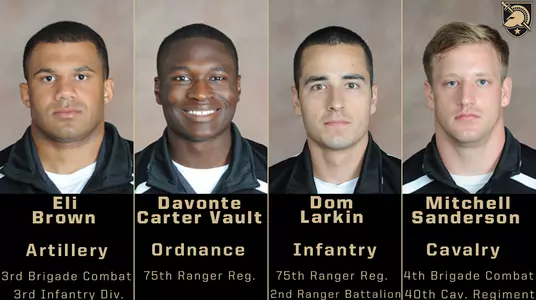
Mitchell Sanderson, Eli Brown, Davonte Carter Vault and manager Dom Larkin each came to the banks of the Hudson through a unique journey during their previous deployments overseas as part of the United States Army.
Mitchell Sanderson
For Sanderson, joining the Army was like a family business. His entire family has been in the military, from his mother, Mary, who was an automated logistical specialist as a 92A, to his father, Kenneth, who served as a military policeman at the Pentagon before enrolling at the University of Minnesota. He eventually become commissioned as a second lieutenant in field artillery.
Additionally, his sister is in the Air Force and his brother is in the Marines.
"My dad just sat me down one day and said you can either go to college or you can go to the Army," said Sanderson. "I chose to start off in the Army to get some experience before I try to do anything else in life."
Sanderson was a member of the 1st Squadron, 40th Cavalry and the 4th Brigade Combat Team (Airborne) during his deployment to Afghanistan, where some of his duties included COIN Operations and recon missions.
"The big thing for Cav is that you're the eyes and ears of the battlefield, so the main purpose is going as far as you can out and do some reconnaissance of an enemy or an area," Sanderson explained. "You're the relay man letting the higher ups know how hot the area is, how big it is or what equipment you can use in the area. A big thing we did on deployment was some COIN Operation missions. We were tasked with integrating with civilians and showing them that we're there to help."
Like his father, Sanderson was looking to commission after attending college by completing a green and gold packet. Many of the commanders and platoon leaders in his unit, as well as many from other units, were West Point graduates. Now intrigued, Sanderson started picking their brains about what the Cadet experience was like at the Academy.
"I got that experience by talking to them and asking them what West Point is, what the culture is like and what the traditions are," Sanderson remembered. "It grew on me and I liked the idea of it, so they helped me put my packet together to apply to West Point."
Sanderson's platoon leader, Lt. Joseph Cabrera was his main influencer.
"When you get a new guy from West Point, there are a lot of different takes on West Point grads," Sanderson said. "In this case, we had a guy who knew what he was doing so any time we did something, he did it flawlessly and to the standard to where it was like we're ready to follow this guy anywhere and I'd give my life for this guy because he has my best interests in mind while we're downrange."
The transition to life as a Cadet here at West Point was easier for Sanderson than it was for most, which he credits to his time in Afghanistan.
While on deployment, he would be doing what West Point has its Cadets do physically, which taught him what the rules and standards are. The military aspect of the Academy was the greatest advantage Sanderson saw from his prior service, having already learned the military training. This allowed him to go out and help others and give them new ideas on how to get a job completed in an abstract way besides what a text book might suggest.
This was not only helpful in his own development, but aiding his peers in the other areas allowed them to repay him in an area he was a little rusty in: academics.
"You can use that as a good trade off," Sanderson explained. "I helped others on the military side of things and they would help me out with academics. With me being out of school for so long, that was a game changer as I acclimated myself to being a student again."
Sanderson's experiences overseas not only help him in his life as a Cadet, but also on the rugby pitch.
"Every time you go out onto the pitch and you play a game, it's more like a test or war against another team," described Sanderson. "You've got the other 14 members who are on the field with you who are fighting to win the game. That goes back to your platoon itself. You create the bond that's really tight, and here, this team itself is very close. You can see all of the dog tags of the fallen brothers and see that we take it very seriously. Everybody who commissions from the rugby team has been very successful. While you're on the team, you have the aspect of being a leader as well, so it transitions to becoming a commissioned leader in the future."
Eli Brown
Growing up in Jacksonville, Fla., Brown often found himself making decisions that he knew needed changing. Coming out of high school, he found a way to start fresh.
"I didn't know what direction I wanted to go in life after high school," Brown mentioned. "I knew I had to make some changes to how I was living and to grow up. The Army was a good way to do something productive for my country and also benefit by getting some structure along the way. The biggest thing for me was accountability and being accountable for your personal actions and being a better person moving forward."
Brown served as a team leader in the 3rd Brigade Combat Team, 3rd Infantry Division in Kuwait, where he supported regional partners with operational missions, bilateral, multilateral military exercises and theater security cooperation activities.
"As a team leader, I was not only responsible for myself, but also checking up on four or five other soldiers," Brown explained. "That included checking equipment if we were doing training, as well as seeing how things were in their personal lives and looking out for their wellbeing."
Brown moved his way up from there.
"I was on the M109A6 self-propelled howitzer and started off in the ammo vehicle where I prepared the 155-millimeter artillery projectiles and the powder charges that go with it," Brown mentioned. "I started out there, then worked my way up to the No. 1 cannoneer who was in charge of loading and firing the round before becoming the gunner. You're checking the lay of the gun so you know it's shooting in the direction you're trying to go to."
After righting his own ship, Brown learned that he was able to apply to colleges as a prior service member after talking with his superiors.
"All of my superiors and squad leaders over the years helped me get to where I am, but the biggest influence was my battalion commander, Lt. Col. Kevin Capra (USMA '95)," Brown explained. "When I found out I was able to apply as prior service, he really helped me see which direction I wanted to go."
Brown wasn't sure at the beginning, but Capra convinced him.
"I was on the fence at first, but I knew that it was such a tremendous opportunity to be able to ask him what it's like at the Academy," Brown stated. "What cadets do and what it's like being an officer in your experiences throughout the years. He wrote my commander's endorsement and was just a major player throughout the entire process."
Brown was eased back into the academic life style by spending a year at the prep school before getting to West Point, which certainly proved to be beneficial for him to get back into the swing of things in the classroom.
"There wasn't as much of a military shock, which can happen with such a rigid structure," said Brown. "I already knew the drill and ceremonies, the customs and courtesies and the training aspects. That background allowed me to help my peers and develop the relationships that would help me with something I may struggle in like transitioning back into the classroom. It lightened my load because there's still the military background here at the Academy so I was able to focus on areas in which I needed to improve."
The preparation that he learned from his prior service which benefited him in his Cadet life also aided Brown on the pitch. Comparing it to planning for a mission or training exercise, you go over what your desired objective is and how you are going to achieve it. The planning is not just for how to make the mission a successful one, however, as you also need to strategize how to operate when things do not go as planned.
"Whether it's in the Army or on the rugby pitch, things aren't going to go as planned," Brown explained. "Being able to think on your feet and adjust when the situation doesn't develop exactly as you would expect is pivotal in both aspects."
The rugby squad talks a lot about accountability and that has some similarities to the army.
"If you're supposed to execute a certain job within your team or the army, your teammates are going to have that trust that you're going to do it," Brown said. "Tying in with the accountability is the resilience I learned from my prior service. You're going to be put into tough situations, whether it's an unexpected injury or a personal problem with a teammate, you've got to have that resilience to keep pushing on. The game doesn't stop. Life doesn't stop. You've got to keep pushing on and bounce back."
Davonte Carter Vault
A lack of direction was the best thing for Carter Vault as he graduated from high school in 2012. Feeling confused about what his next step was and not committing to any college for the fall, he heard someone recommend joining the Army which was an opportunity that sounded appealing.
Carter Vault was deployed to Afghanistan where he was a member of the 75th Ranger Regiment. His main duties were radio telephone operations and network administration.
"I was assigned to a signal shop so I set up radios, managed networks and computers and was the radio telephone operation," Carter Vault explained. "When I went out into the field, I was the one talking on the radio. Mostly, I made sure everyone else's radio was working and I would pass some of the smaller things up through the chain of command. I would let them know when we come into contact, when in filling and ex filling."
This job did not come without excitement, as the Upland, Calif., native recalls an exhilarating experience that occurred within his first month overseas.
"You always remember the first time you take fire," reminisced Carter Vault. "I was walking around and had only been there for a week or two. We were still doing a hand over so we weren't going out on missions or anything so we didn't expect an attack, but a rocket fired from outside of the boarder landed about 100 meters away from me."
Upon enlisting in the Army, Carter Vault knew that he wanted to go back to school and eventually become an officer.
"I just wasn't sure how to do it," confessed Carter Vault. "I got my first email about West Point when I was in Advanced Individual Training (AIT), and I applied for it. It was at the same time I was offered to go to ranger regiment, however, and I decided to go there."
He was very persistent after that first email about West Point and third time became the charm.
"I actually applied to West Point three times, and this last time was the first time I went through the entire process," Carter Vault said. "I had a lot more support from outside people like officers who were in my unit who were encouraging me. One time, I got a phone call when I was sitting in a class and he said, 'Let me know right now if you want to go to West Point. I'm going to make this happen, I just need your full commitment.' I ended up completing my entire packet in three days."
While the process was long and strenuous, Carter Vault received help along the way from those in his regiment who provided insight and encouragement as he attempted to return to school.
"A lot of people who are in ranger regiment are West Point grads who graduated together, but the one that I remember the most was Capt. Mason Thornal," Carter Vault explained. "He was a big help to me by giving me some insight into his time here and told me about the good and the bad so go ahead and accept that it is going to challenge you and push you to the brink, but when you look back you'll realize it was one of the best experiences you've ever had. His personal encouragement did the most for me."
Carter Vault picked up some small leadership roles while on his deployment, which was the first time he was in control of people as a team leader. This gave him an opportunity to get some experience as a leader and start to develop his personal leadership style, which is a skill he uses every day here at the Academy.
Along with that leadership, he also learned the grit and determination it takes to not only succeed at West Point, but also on the rugby pitch.
"Sometimes you go through a lot of ruck marches where you need to tell yourself to keep pushing forward, and it's the same thing at rugby," described Carter Vault. "You're out there and feeling the pain. Your chest is burning and your lungs are on fire right now, but you can't stop and let my brothers down. If I let them down on the battlefield, it's going to be that much worse."
DOM LARKIN
Larkin's father was enlisted for more than 11 years as a captain in the Army's 3rd Ranger Battalion. As a result, it was not a question of if he wanted to serve, but when.
"I always looked up to my father," said Larkin. "He was a very confident and knowledgeable person. Nobody in our family had ever gone to college before him, so the process of applying for college was foreign to me. I decided to get some experience in the Army and go serve our country."
Larkin operated an M249 and MK 48 machine gun while he was deployed in Afghanistan as a member of the 75th Ranger Regiment 2nd Battalion which is the position you hold before becoming a sergeant. Toward the end of his deployment, Larkin was the 50 Cal. Gunner for the vehicle platoon whenever they sent their strikers out.
Like his idol, Larkin was poised to become an officer after earning his college degree. Despite not knowing the exact procedure on how to accomplish that goal, Larkin willed his way into doing whatever it took to figure it out.
"My father helped a lot, as well as an officer here at West Point who is in charge of helping enlisted soldiers apply and push their packets along," Larkin explained. "I was actually deployed in Afghanistan when admissions window opened up. Not only finding time, but getting to a computer and open my packet and work on it was difficult. I came back a month early from my deployment to go to ranger school and had about a three-month window to knock everything out. In the pre-ranger course, I was allowed to have my phone so I was making a lot of calls while applying to come here."
Once admitted to the Academy, Larkin's will was truly tested, especially in his first year. He was struggling a lot with his academics as a freshman, but was working through the struggles to push forward, something he credits heavily to his involvement in the ranger regiment.
"Coming from ranger regiment, you learn how to take initiative and how to figure things out on your own," Larkin described. "Whenever you're not actively doing something to better yourself or to accomplish a task, you're going to get hounded in regiment. You never see guys standing still, whether it's on deployment or back in garrison. They're constantly training and getting better. I feel like that helped me a lot through my struggles academically as a freshman. I think the reason I didn't get kicked out was because of the number of different people who saw me trying to better myself and figure out how to be a student. I was an average student in high school, but I'm starting to do better than that here because I'm learning how to seek out my resources and use them."
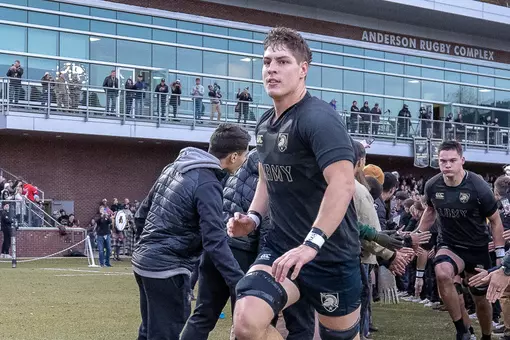
Larkin was a member of the rugby team in its inaugural varsity season of 2014-15, starting in the spring at fly half. The Anderson Rugby Complex was one place on Post where he could unwind and just focus on something besides school.
"Whenever I came down to the Anderson Rugby Complex, my only focus was getting better," Larkin expressed. "When I got to West Point, I had only played about four months of sevens at the prep school. I had to come down here early and stay late in order to get better."
Despite having limited experience in the sport, Larkin used some of the skills he learned from his deployment on the pitch.
"The rugby field is pretty much like war," Larkin stated. "You've got to trust the guy to your left and right to do his job to not only cover his man, but also give 100 percent all the time. I was fortunate enough to be in a unit that was the same way when I was enlisted. We trained so much that we trusted everyone to our left and right to get the job done and doing it to the best of their abilities. It's mostly mental. If you're mentally prepared, that will make up for anything you lack physically."
Click here to read previous Feature Friday stories.
The traditional path to West Point is to be a direct admit or spend a year at the prep school, but for four select members of the Army West Point men's rugby program, they felt serving this country was something they wanted to do before going to college.
Mitchell Sanderson, Eli Brown, Davonte Carter Vault and manager Dom Larkin each came to the banks of the Hudson through a unique journey during their previous deployments overseas as part of the United States Army.
Mitchell Sanderson
For Sanderson, joining the Army was like a family business. His entire family has been in the military, from his mother, Mary, who was an automated logistical specialist as a 92A, to his father, Kenneth, who served as a military policeman at the Pentagon before enrolling at the University of Minnesota. He eventually become commissioned as a second lieutenant in field artillery.
Additionally, his sister is in the Air Force and his brother is in the Marines.
"My dad just sat me down one day and said you can either go to college or you can go to the Army," said Sanderson. "I chose to start off in the Army to get some experience before I try to do anything else in life."
Sanderson was a member of the 1st Squadron, 40th Cavalry and the 4th Brigade Combat Team (Airborne) during his deployment to Afghanistan, where some of his duties included COIN Operations and recon missions.
"The big thing for Cav is that you're the eyes and ears of the battlefield, so the main purpose is going as far as you can out and do some reconnaissance of an enemy or an area," Sanderson explained. "You're the relay man letting the higher ups know how hot the area is, how big it is or what equipment you can use in the area. A big thing we did on deployment was some COIN Operation missions. We were tasked with integrating with civilians and showing them that we're there to help."
Like his father, Sanderson was looking to commission after attending college by completing a green and gold packet. Many of the commanders and platoon leaders in his unit, as well as many from other units, were West Point graduates. Now intrigued, Sanderson started picking their brains about what the Cadet experience was like at the Academy.
"I got that experience by talking to them and asking them what West Point is, what the culture is like and what the traditions are," Sanderson remembered. "It grew on me and I liked the idea of it, so they helped me put my packet together to apply to West Point."
Sanderson's platoon leader, Lt. Joseph Cabrera was his main influencer.
"When you get a new guy from West Point, there are a lot of different takes on West Point grads," Sanderson said. "In this case, we had a guy who knew what he was doing so any time we did something, he did it flawlessly and to the standard to where it was like we're ready to follow this guy anywhere and I'd give my life for this guy because he has my best interests in mind while we're downrange."
The transition to life as a Cadet here at West Point was easier for Sanderson than it was for most, which he credits to his time in Afghanistan.
While on deployment, he would be doing what West Point has its Cadets do physically, which taught him what the rules and standards are. The military aspect of the Academy was the greatest advantage Sanderson saw from his prior service, having already learned the military training. This allowed him to go out and help others and give them new ideas on how to get a job completed in an abstract way besides what a text book might suggest.
This was not only helpful in his own development, but aiding his peers in the other areas allowed them to repay him in an area he was a little rusty in: academics.
"You can use that as a good trade off," Sanderson explained. "I helped others on the military side of things and they would help me out with academics. With me being out of school for so long, that was a game changer as I acclimated myself to being a student again."
Sanderson's experiences overseas not only help him in his life as a Cadet, but also on the rugby pitch.
"Every time you go out onto the pitch and you play a game, it's more like a test or war against another team," described Sanderson. "You've got the other 14 members who are on the field with you who are fighting to win the game. That goes back to your platoon itself. You create the bond that's really tight, and here, this team itself is very close. You can see all of the dog tags of the fallen brothers and see that we take it very seriously. Everybody who commissions from the rugby team has been very successful. While you're on the team, you have the aspect of being a leader as well, so it transitions to becoming a commissioned leader in the future."
Eli Brown
Growing up in Jacksonville, Fla., Brown often found himself making decisions that he knew needed changing. Coming out of high school, he found a way to start fresh.
"I didn't know what direction I wanted to go in life after high school," Brown mentioned. "I knew I had to make some changes to how I was living and to grow up. The Army was a good way to do something productive for my country and also benefit by getting some structure along the way. The biggest thing for me was accountability and being accountable for your personal actions and being a better person moving forward."
Brown served as a team leader in the 3rd Brigade Combat Team, 3rd Infantry Division in Kuwait, where he supported regional partners with operational missions, bilateral, multilateral military exercises and theater security cooperation activities.
"As a team leader, I was not only responsible for myself, but also checking up on four or five other soldiers," Brown explained. "That included checking equipment if we were doing training, as well as seeing how things were in their personal lives and looking out for their wellbeing."
Brown moved his way up from there.
"I was on the M109A6 self-propelled howitzer and started off in the ammo vehicle where I prepared the 155-millimeter artillery projectiles and the powder charges that go with it," Brown mentioned. "I started out there, then worked my way up to the No. 1 cannoneer who was in charge of loading and firing the round before becoming the gunner. You're checking the lay of the gun so you know it's shooting in the direction you're trying to go to."
After righting his own ship, Brown learned that he was able to apply to colleges as a prior service member after talking with his superiors.
"All of my superiors and squad leaders over the years helped me get to where I am, but the biggest influence was my battalion commander, Lt. Col. Kevin Capra (USMA '95)," Brown explained. "When I found out I was able to apply as prior service, he really helped me see which direction I wanted to go."
Brown wasn't sure at the beginning, but Capra convinced him.
"I was on the fence at first, but I knew that it was such a tremendous opportunity to be able to ask him what it's like at the Academy," Brown stated. "What cadets do and what it's like being an officer in your experiences throughout the years. He wrote my commander's endorsement and was just a major player throughout the entire process."
Brown was eased back into the academic life style by spending a year at the prep school before getting to West Point, which certainly proved to be beneficial for him to get back into the swing of things in the classroom.
"There wasn't as much of a military shock, which can happen with such a rigid structure," said Brown. "I already knew the drill and ceremonies, the customs and courtesies and the training aspects. That background allowed me to help my peers and develop the relationships that would help me with something I may struggle in like transitioning back into the classroom. It lightened my load because there's still the military background here at the Academy so I was able to focus on areas in which I needed to improve."
The preparation that he learned from his prior service which benefited him in his Cadet life also aided Brown on the pitch. Comparing it to planning for a mission or training exercise, you go over what your desired objective is and how you are going to achieve it. The planning is not just for how to make the mission a successful one, however, as you also need to strategize how to operate when things do not go as planned.
"Whether it's in the Army or on the rugby pitch, things aren't going to go as planned," Brown explained. "Being able to think on your feet and adjust when the situation doesn't develop exactly as you would expect is pivotal in both aspects."
The rugby squad talks a lot about accountability and that has some similarities to the army.
"If you're supposed to execute a certain job within your team or the army, your teammates are going to have that trust that you're going to do it," Brown said. "Tying in with the accountability is the resilience I learned from my prior service. You're going to be put into tough situations, whether it's an unexpected injury or a personal problem with a teammate, you've got to have that resilience to keep pushing on. The game doesn't stop. Life doesn't stop. You've got to keep pushing on and bounce back."
Davonte Carter Vault
A lack of direction was the best thing for Carter Vault as he graduated from high school in 2012. Feeling confused about what his next step was and not committing to any college for the fall, he heard someone recommend joining the Army which was an opportunity that sounded appealing.
Carter Vault was deployed to Afghanistan where he was a member of the 75th Ranger Regiment. His main duties were radio telephone operations and network administration.
"I was assigned to a signal shop so I set up radios, managed networks and computers and was the radio telephone operation," Carter Vault explained. "When I went out into the field, I was the one talking on the radio. Mostly, I made sure everyone else's radio was working and I would pass some of the smaller things up through the chain of command. I would let them know when we come into contact, when in filling and ex filling."
This job did not come without excitement, as the Upland, Calif., native recalls an exhilarating experience that occurred within his first month overseas.
"You always remember the first time you take fire," reminisced Carter Vault. "I was walking around and had only been there for a week or two. We were still doing a hand over so we weren't going out on missions or anything so we didn't expect an attack, but a rocket fired from outside of the boarder landed about 100 meters away from me."
Upon enlisting in the Army, Carter Vault knew that he wanted to go back to school and eventually become an officer.
"I just wasn't sure how to do it," confessed Carter Vault. "I got my first email about West Point when I was in Advanced Individual Training (AIT), and I applied for it. It was at the same time I was offered to go to ranger regiment, however, and I decided to go there."
He was very persistent after that first email about West Point and third time became the charm.
"I actually applied to West Point three times, and this last time was the first time I went through the entire process," Carter Vault said. "I had a lot more support from outside people like officers who were in my unit who were encouraging me. One time, I got a phone call when I was sitting in a class and he said, 'Let me know right now if you want to go to West Point. I'm going to make this happen, I just need your full commitment.' I ended up completing my entire packet in three days."
While the process was long and strenuous, Carter Vault received help along the way from those in his regiment who provided insight and encouragement as he attempted to return to school.
"A lot of people who are in ranger regiment are West Point grads who graduated together, but the one that I remember the most was Capt. Mason Thornal," Carter Vault explained. "He was a big help to me by giving me some insight into his time here and told me about the good and the bad so go ahead and accept that it is going to challenge you and push you to the brink, but when you look back you'll realize it was one of the best experiences you've ever had. His personal encouragement did the most for me."
Carter Vault picked up some small leadership roles while on his deployment, which was the first time he was in control of people as a team leader. This gave him an opportunity to get some experience as a leader and start to develop his personal leadership style, which is a skill he uses every day here at the Academy.
Along with that leadership, he also learned the grit and determination it takes to not only succeed at West Point, but also on the rugby pitch.
"Sometimes you go through a lot of ruck marches where you need to tell yourself to keep pushing forward, and it's the same thing at rugby," described Carter Vault. "You're out there and feeling the pain. Your chest is burning and your lungs are on fire right now, but you can't stop and let my brothers down. If I let them down on the battlefield, it's going to be that much worse."
DOM LARKIN
Larkin's father was enlisted for more than 11 years as a captain in the Army's 3rd Ranger Battalion. As a result, it was not a question of if he wanted to serve, but when.
"I always looked up to my father," said Larkin. "He was a very confident and knowledgeable person. Nobody in our family had ever gone to college before him, so the process of applying for college was foreign to me. I decided to get some experience in the Army and go serve our country."
Larkin operated an M249 and MK 48 machine gun while he was deployed in Afghanistan as a member of the 75th Ranger Regiment 2nd Battalion which is the position you hold before becoming a sergeant. Toward the end of his deployment, Larkin was the 50 Cal. Gunner for the vehicle platoon whenever they sent their strikers out.
Like his idol, Larkin was poised to become an officer after earning his college degree. Despite not knowing the exact procedure on how to accomplish that goal, Larkin willed his way into doing whatever it took to figure it out.
"My father helped a lot, as well as an officer here at West Point who is in charge of helping enlisted soldiers apply and push their packets along," Larkin explained. "I was actually deployed in Afghanistan when admissions window opened up. Not only finding time, but getting to a computer and open my packet and work on it was difficult. I came back a month early from my deployment to go to ranger school and had about a three-month window to knock everything out. In the pre-ranger course, I was allowed to have my phone so I was making a lot of calls while applying to come here."
Once admitted to the Academy, Larkin's will was truly tested, especially in his first year. He was struggling a lot with his academics as a freshman, but was working through the struggles to push forward, something he credits heavily to his involvement in the ranger regiment.
"Coming from ranger regiment, you learn how to take initiative and how to figure things out on your own," Larkin described. "Whenever you're not actively doing something to better yourself or to accomplish a task, you're going to get hounded in regiment. You never see guys standing still, whether it's on deployment or back in garrison. They're constantly training and getting better. I feel like that helped me a lot through my struggles academically as a freshman. I think the reason I didn't get kicked out was because of the number of different people who saw me trying to better myself and figure out how to be a student. I was an average student in high school, but I'm starting to do better than that here because I'm learning how to seek out my resources and use them."
Larkin was a member of the rugby team in its inaugural varsity season of 2014-15, starting in the spring at fly half. The Anderson Rugby Complex was one place on Post where he could unwind and just focus on something besides school.
"Whenever I came down to the Anderson Rugby Complex, my only focus was getting better," Larkin expressed. "When I got to West Point, I had only played about four months of sevens at the prep school. I had to come down here early and stay late in order to get better."
Despite having limited experience in the sport, Larkin used some of the skills he learned from his deployment on the pitch.
"The rugby field is pretty much like war," Larkin stated. "You've got to trust the guy to your left and right to do his job to not only cover his man, but also give 100 percent all the time. I was fortunate enough to be in a unit that was the same way when I was enlisted. We trained so much that we trusted everyone to our left and right to get the job done and doing it to the best of their abilities. It's mostly mental. If you're mentally prepared, that will make up for anything you lack physically."
Click here to read previous Feature Friday stories.

Players Mentioned
Prop
/ Men's Rugby
Center
/ Men's Rugby
Lock
/ Men's RugbyArmy vs Air Force
Saturday, October 29
Army vs St. Bonaventure
Sunday, October 02
Army vs Kutztown
Friday, September 09
Army vs. Life
Saturday, April 16